
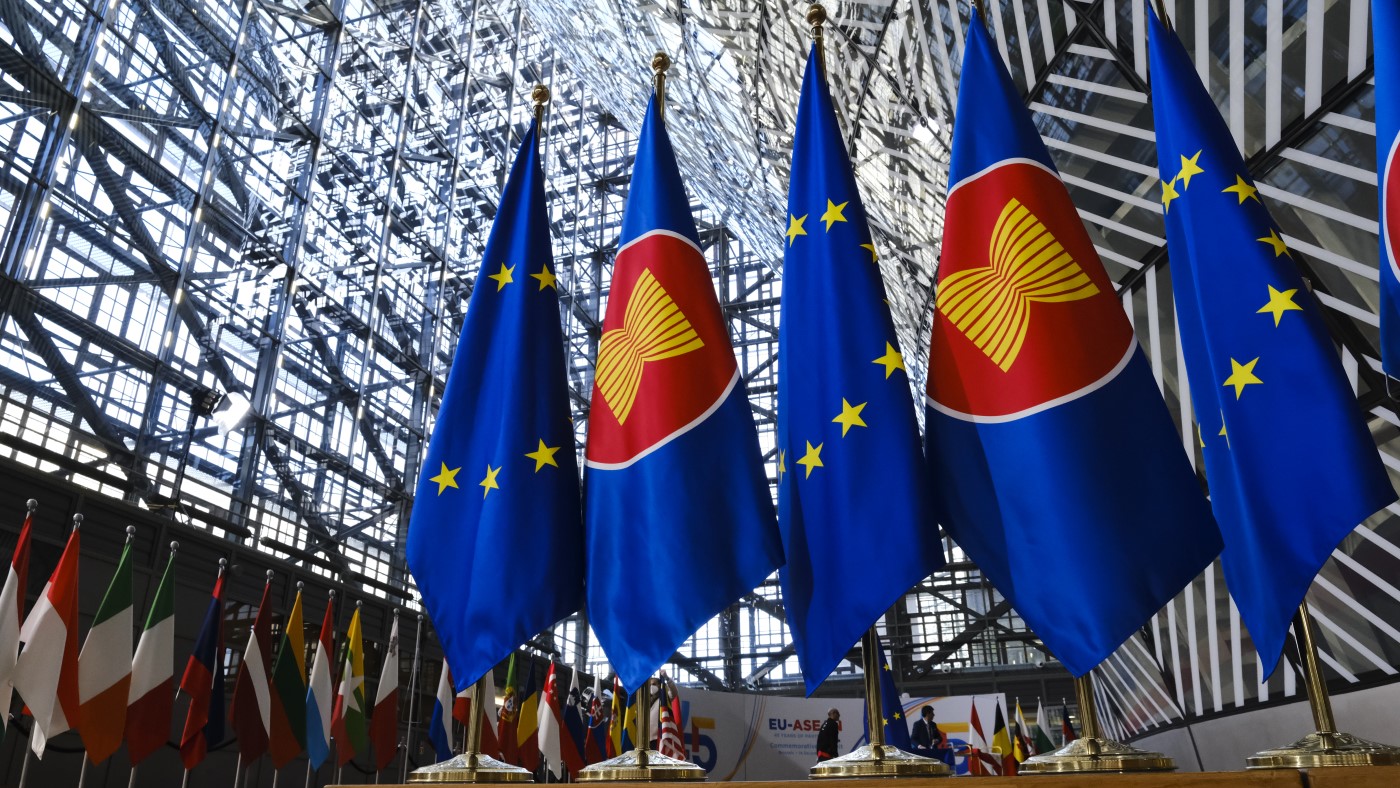

After the deal signed with Indonesia, Brussels aims to conclude other negotiations. By 2026, agreements with Thailand, the Philippines, and Malaysia could be finalized
Di Alessandro Forte
September 23, 2025 adds another piece to the long and complex puzzle of bilateral relations between the European Union and ASEAN countries: Commission President Von der Leyen and Indonesian President Subianto have concluded a Free Trade Agreement (FTA) and an Investment Protection Agreement (IPA) after nine years of negotiations, pending formal approval by the Member States and the European Parliament. This agreement fits into a much broader political and commercial framework for Brussels, which views the region as not only a solid economic partner, but above all a strategic opportunity. In 2024, ASEAN confirmed its role as the EU’s third-largest trading partner, with a goods exchange worth €258.7 billion (9.6% of the Asian bloc’s total trade), and stands out as a crucial manufacturing and logistics hub for access to the Indo-Pacific area, serving as a bridge between advanced and developing economies, and as a key node in supply chains—among them electronics and automotive.
In this context, Jakarta and Brussels agreed to eliminate tariffs on more than 90% of products as soon as the deal enters into force, including the 50% tariffs on EU automobiles, which will be gradually phased out within five years. The Indonesian president, in this regard, expressed confidence that these conditions will double bilateral trade within the first five years.
Moreover, the newly signed agreement marks the third achievement rewarding the EU’s bilateral approach toward ASEAN countries. Indeed, after the attempt in 2007 to negotiate a region-to-region agreement, the process stalled and was suspended in 2009 due to regulatory heterogeneity among Southeast Asian countries. This, however, did not prevent Brussels from concluding FTAs with Singapore in 2019—with an IPA pending ratification—and with Vietnam in 2020, opening up broader product and service diversification in the region. From a strategic standpoint, the Singapore–Indonesia pairing—respectively a services champion and a demographic powerhouse rich in raw materials—inevitably sends a positive signal for the negotiations that are still on hold.
For Thailand, ASEAN’s automotive hub, the Indonesian precedent on progressive tariff dismantling in the sector acts as a regulatory facilitator, reducing investment uncertainty and opening the door to a more realistic and extensive integration of regional value chains. For Malaysia, the world’s second-largest palm oil producer after Jakarta, the removal of EU tariffs on the product creates a more attractive negotiating scenario, while maintaining European standards on food safety and sustainability. For the Philippines, where services account for 63.2% of GDP, an FTA modeled after the Singapore deal would bring interoperability in digital services, streamlined procedures for licensing and payments, and common frameworks for fintech and open banking, making EU market access more immediate for Filipino operators.
One question remains: does a regional EU–ASEAN agreement still make sense? The short answer is yes—but not in the immediate future. The bilateral path, however, should not be seen as an alternative to a region-to-region deal, but rather as a pragmatic way to gradually align agreements with other Southeast Asian countries, building a broader framework that lowers compliance costs for businesses and strengthens ASEAN integration. In the medium term, this could certainly create fertile ground for a credible regional agreement. The global context, moreover, pushes in the same direction: amid rising U.S. tariffs and persistent dependence on the Chinese market, for both the EU and ASEAN, supply chain diversification is no longer an option, but a strategic necessity. Hence the urgency of transforming bilateral progress into a shared roadmap, with concrete objectives and defined timelines.







 English
  Italian