
Five countries inaugurate ASEAN network for QR Code payments

Malaysia, Indonesia, Thailand, Singapore and the Philippines have interconnected their national QR code payment platforms. Consumers will be able to instantly make payments, including in foreign currency, with reduced costs for both them and sellers. The region solidifies its position as a global fintech hub.

Last June, Malaysia and Indonesia connected their digital payment platforms based on QR code technology. Kuala Lumpur had already completed the connection with Singapore in April and, even earlier, with Thailand. These initiatives are not isolated or bilateral but are part of a coordinated ASEAN project that also involves the Philippines. Five prominent economies in the region have decided to coordinate the technical standards of their respective national platforms, creating a network that allows users to make payments using their national provider's QR codes issued in another country. The project also enables instant currency conversion. The initiative was announced last year during the G20 summit of finance ministers and central bank governors, chaired by Indonesia. The five partners intend to continue the project, and in the future, consumers may also be able to make instant transfers or purchase national digital currencies through platform interconnections. Other countries may also join the network.

The ASEAN initiative is part of a global context of rapid QR code development, increasingly used for digital payments. By 2025, this payment method could move $3 trillion globally. Its main strength lies in its accessibility, as in certain regions of the world, owning a smartphone is much easier than having a credit card. This condition could enable Southeast Asia to drive “a digital payment revolution". Over 50% of ASEAN consumers living in urban areas already use e-wallets for their payments, and this number is expected to reach 84% by 2025. The figures are not equally impressive in rural areas, where less than 20% of consumers used e-wallets in 2020, but this number is projected to approach 60% by 2025. This trend aligns with what is happening in China with Alipay and WeChat. The main barrier to this conversion is the scepticism of merchants who consider the transactions to be unreliable and too costly, leading them to reject electronic methods. However, the adoption of QR codes and their ASEAN-level interconnection provides a response to these concerns and will undoubtedly contribute to the spread of digital wallets. QR code advocates also claim that the method is safer, as it requires less personal data to be provided to sellers.

This "revolution" will have an impact on the future development of many sectors of the economy, creating winners and losers. Traditional banks, already less present in certain areas of ASEAN countries, risk being replaced by fintech competitors. To pay with a credit card or withdraw cash from an ATM, a current account and a physical distribution network are required. These are not easy obstacles for traditional banks to overcome due to costs and difficulties in obtaining creditworthiness information about potential customers. Fintech companies, on the other hand, are not burdened by these requirements and can more easily attract new customers in Southeast Asia and extract value from their transaction data. It is a market with immense potential, and "unlocking" it will allow ASEAN companies to further grow and consolidate the region's position as a global laboratory for digital and fintech innovation.

However, these initiatives also have a political dimension. QR codes reduce the costs of individual transactions and, as mentioned earlier, are easily accessible even to individuals normally excluded from traditional banking channels. The so-called "financial inclusivity," which aims to make the financial system accessible to the middle class and those living in rural areas, is a strategic objective for ASEAN governments and can make their economies more prosperous and competitive. Moreover, the fact that the coordination of technical standards occurred at the ASEAN level, rather than just bilaterally, is evidence of the organization's potential as a forum to discuss and strengthen regional integration, both economically and digitally. However, this project is limited to some of the most competitive and closely aligned economies within the organization. Which other national platforms could join in the future? Vietnam has already worked with Thailand to connect their QR payment systems, and if it participates in the network with the other four countries, all the wealthiest economies in the region would be part of it. Involving smaller countries with fewer resources is more challenging.

The political impact of this initiative goes beyond ASEAN. The coordination of QR platforms allows consumers to instantly pay bills in foreign currency with minimal exchange rates. In practice, the system converts ASEAN currencies directly, without the need for US dollar intermediation. The digitalization of money flows thus poses an additional challenge to the centrality of the American currency in international exchanges. Lastly, strengthening ASEAN as an innovative and dynamic digital hub enhances the region's role in defining future technological standards. Perhaps even capable of carving out a space amidst the US-China duopoly. Coordinating and facilitating electronic payments creates new opportunities. It is curious to observe that, on the other hand, in Italy and other European countries, it is sometimes still challenging to pay with a credit card, and preserving the role of cash is a political issue. This approach is completely opposite to the dynamism demonstrated by Asian companies and governments, slowing down the progress of our economies towards the new digital "revolution."

EU and Philippines towards free trade

Important visit to Manila by European Commission President Ursula Von Der Leyen. Moving toward a free trade agreement

Article by Tommaso Magrini

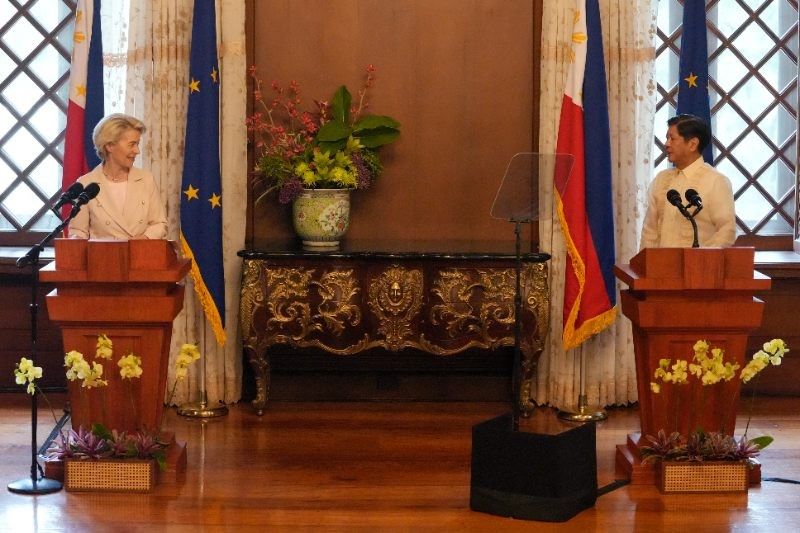
An important visit to the Philippines by Ursula Von der Leyen took place in recent days. She met with President Ferdinand Marcos Junior at the presidential palace in Malacañang. Here Von der Leyen expressed her intention to give "a new impetus to bilateral relations between the European Union and the Philippines." At the top of the agenda: trade, ecological transition, digital innovation and security. On the first item, the two leaders announced their intention to pursue the relaunch of negotiations for an "ambitious, modern and balanced free trade agreement focused on sustainability." An ambitious plan, which follows the free trade agreements concluded by the European Union with Singapore and Vietnam in past years. A testament to the fact that Brussels has its sights set on Southeast Asia, a high-growth area that also allows for a diversification of trade and diplomatic relations in the Asian region from China. "The Philippines is a key partner for us in the Indo-Pacific region, and with the launch of this assessment process we are paving the way to take our partnership to the next level," von der Leyen said. "Together, we will realize the full potential of our relationship, creating new opportunities for our businesses and consumers, while also supporting the green transition and promoting a just economy." For her, the future free trade agreement will include ambitious commitments on market access, fast and effective sanitary and phytosanitary procedures, and the protection of intellectual property rights, including geographical indications." Also at the center, however, is the issue of sustainability, a dossier on which an announcement has already come during the visit. Indeed, Von der Leyen and Marcos launched the Team Europe initiative on the green economy, which includes an EU contribution of 466 million euros for "green" waste management. All under the Global Gateway program launched by the European Commission. Also planned is the transfer of skills, training and technology aimed at building an alternative plastic waste management model. "The Philippines and the EU are kindred partners because of our shared values of democracy, sustainable and inclusive prosperity, rule of law, peace and stability, and human rights," Marcos said instead. "The ongoing exchanges between President von der Leyen and myself, which began in Brussels last year, testify to our common desire to take our bilateral relations to higher levels," he added.

EU-ASEAN, towards new forms of cooperation?

We publish here an excerpt from the introduction of the Carnegie Endowment for International Peace report : “Rethinking EU-ASEAN Relations: Challenges and Opportunities”.

The European Union (EU) and the Association of Southeast Asian Nations (ASEAN) formally marked almost half a century of diplomatic ties at the end of 2022. The summit commemorating the forty-five years of the two blocs was held in Brussels. Paradoxically, despite escalating tensions over the security sphere in both regions, the security dossier has not been central to the EU-ASEAN agenda. This is symptomatic not only of the way the two organisations view each other's capabilities and interests in each region, but also of the way the relationship has gone so far. There have been a series of ups and downs, with many of the more contentious issues - particularly the thorny ones relating to democracy and human rights - left to diplomats or addressed by civil society, given the sensitivity at the political level. The main focus of EU-ASEAN relations has been on trade and investment, reflecting the EU's competence vis-à-vis its member states and areas where ASEAN as a whole has slightly more room for manoeuvre. Despite the inability to push forward a free trade agreement (FTA) between the EU and ASEAN, which has stalled since 2007, the EU has made progress with bilateral FTAs with individual ASEAN member states, including Singapore and Vietnam. On the foreign policy front, both the EU and ASEAN face difficulties. EU members have never made progress in ceding full control of external engagement to the EU's executive arm. Despite the ratification of the Lisbon Treaty in 2009, EU member states have continued to retain national competence over the many challenges affecting the Union's Common Foreign and Security Policy. ASEAN acts in much the same way, but much more strongly favours the prerogatives of individual member states. And there has never been any ambition or coordinated attempt to outsource ASEAN's foreign policy efforts to the regional secretariat. However, over the past decade or so, the geopolitical landscapes in Europe and Asia have changed significantly, leaving the EU and ASEAN exposed to critical economic and security vulnerabilities over which they have limited control. This is why the EU and ASEAN can work together and create a space that is based on their cooperation. The EU and ASEAN have a mutual need for each other's presence in international affairs and a relationship based on genuine cooperation and delivery of concrete results.

The future of ASEAN's youth

The economic growth of Southeast Asian countries will depend largely on the ability of governments to value their young people 

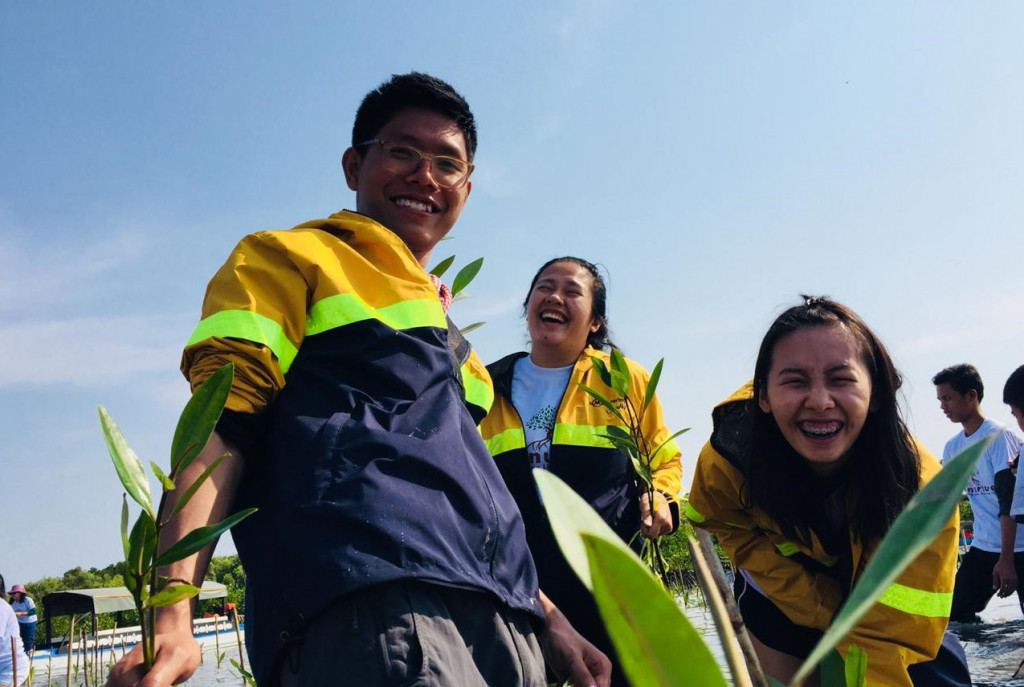
Southeast Asia is one of the most dynamic and fastest growing regions in the world from a labor market perspective. With a total of about 700 million people, the region has a young, dynamic and increasingly educated population. From 1950 to 2020, the Southeast's working-age population grew from 95 million to 453 million. As the working-age population has grown faster than the non-working-age population, the economy's dependency ratio, i.e., the ratio of people considered "non-self-employed" due to age to people who are able to work, has declined leading to a phase of economic growth.

Unfortunately, however, this demographically favorable condition is not likely to last much longer. In Thailand, for example, it is estimated that as early as 2050 the number of people in the 20-64 age group will be 21 percent lower than in 2020. Moreover, if at the moment the average age in ASEAN countries turns out to be 30 in 2050 it will rise to 37.3 years showing that Southeast Asian countries will also move toward a phase characterized by a gradual aging of the population in which economic growth will depend more on the productivity and skill level of young people. As stated by Martijn Schouten, "workforce transformation leader" in Singapore for PWC, the need for a process process of skill adjustment and enrichment to create a workforce with digital and green skills has never been more urgent, considering the commitment made by many ASEAN countries to transition to a zero-emission economy. This transition will add roughly 30 million new jobs in Southeast Asia by 2030. 

Therefore, it is critical that governments in the Southeast Asian region invest in the education and training of young people in order to increase productivity and innovation, fostering dynamic and competitive economic growth. An analysis conducted by PWC shows that extensive investment "in upskilling" would also have the potential to increase the region's GDP by 4 percent, thereby unlocking up to 676,000 new jobs by 2030. In terms of employment, the greatest benefits would be in Indonesia, Vietnam and the Philippines. 

Taking note of the situation, many Southeast Asian countries are acting accordingly. For example, in Malaysia, where the under-35s make up about 60 percent of the population, the government has allocated 2.1 billion ringgit of funds in order to empower young people to become productive, innovative and socially responsible citizens; these include an allocation of 500 million for the National Digital Skills Program, aimed at helping young people upgrade their digital skills. There is also an allocation of 150 million euros for the Youth Entrepreneurship Program, aimed at supporting young entrepreneurs and their start-up initiatives. In contrast, the Singapore government has allocated $400 million in grants from the Financial Sector Development Fund (FSDF) through 2025 to support skills training for professionals in the financial sector. Thailand's Ministry of Labor has partnered with Microsoft Thailand to provide digital skills to 4 million people to support key sectors, including manufacturing, creating new jobs and business opportunities. The first phase of the partnership has boosted the digital skills of 280,000 Thai employees from 2020 to 2022, but a plan to create an additional 180,000 job opportunities is already in place.

Cambodia, Hun Sen wins election again

Premier's Cambodian People's Party (CPP) dominated the elections on Sunday, July 23, garnering more than 82 percent of the vote

By Tommaso Magrini

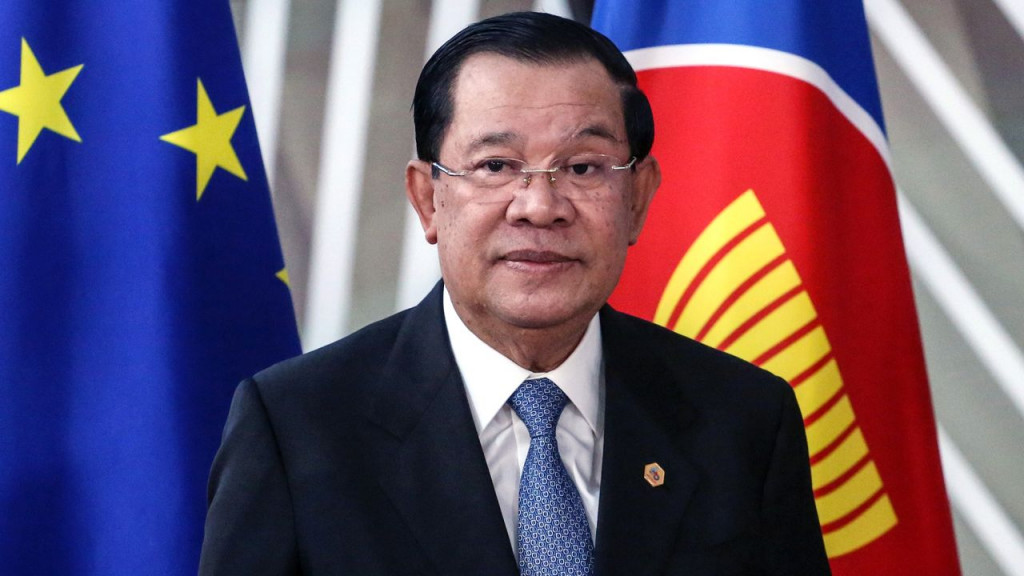
As widely predicted, Prime Minister Hun Sen's Cambodian People's Party (CPP) dominated the elections in Cambodia on Sunday, July 23, garnering more than 82 percent of the vote. In fact, the Cambodian People's Party was unrivaled. The only credible opposition force, the Candlelight Party, was unable to stand in the election due to technical-bureaucratic issues, and the other 17 contending parties were too weak to challenge the prime minister, who has been in power since 1985 with a brief hiatus after the 1993 elections. Hun Sen's party won 120 of the 125 seats in the National Assembly. The royalist Funcinpec got 9.2 percent of the vote winning the remaining five seats. According to official figures, about 84 percent of eligible voters (8.1 million Cambodians out of 9.7 million voters) cast ballots, and 5.7 percent of ballots were invalid (432,000 invalid votes). The government promised legal action against those who spoiled the ballots, a form of protest that opposition members of the CPP had asked to join. Already during the counting stages there were some arrests. After months of speculation, shortly before the vote Hun Sen declared that he would leave the role of premier to his son Hun Manet "within three or four weeks." Hun Manet, commander of the Cambodian army, ran for the first time in this round of elections in one of the seats in the capital Phnom Penh, which he won without issue. In all likelihood, however, Hun Sen will remain chairman of the CPP, a role from which he should be able to maintain control over the government's policy direction. Analysts had expected a longer transition, but Hun Sen would seem to want to accelerate to preside over his son's rise while he is still in strength and with a strong grip on the party and country to which, after the troubled history of the last century, he has been able to ensure stability and economic growth.

Ambassador Mario Vattani bids farewell to Singapore

The diplomat is leaving the city-state. We publish here an excerpt of his farewell to the Italian community, made in a video on YouTube 

As I prepare to leave this office, I would like to say goodbye to the members of our Italian community in Singapore. Your support and presence have been essential in developing this dynamic partnership with Singapore. I believe that we have indeed succeeded in making the opportunities offered by Singapore better known in Italy, and the proof of this are the many agreements signed, the many visits by senior officials we have welcomed, from those responsible for foreign affairs and transport to those for infrastructure, as well as the missions of our Ministry of the Interior, the Bank of Italy and many academics. With this government, Italy is increasingly looking to South-East Asia as a region of great growth for our companies, and the commitment will increase in Singapore given its geopolitical and economic centrality. You will recall that right here, on 1 May, the very first phase of the Indo-Pacific campaign of our most modern navy ship, the Francesco Morosini, began. For us Singapore is an important showcase, a country able to anticipate trends that will be followed by the rest of a region with 600 million inhabitants, and for this reason since I arrived I have tried in every way to increase our visibility with popular events such as the Italian Festival, which totalled something like 300,000 visitors this year. We have also increased our presence from a structural point of view. Since September last year, we have been able to move the Embassy to a new prestigious and central location that also houses a showroom for our companies. We know that one characteristic of Singapore is the high concentration of capital, which is why we launched the Global Sorta last year, successfully bringing our start-ups here. It is no coincidence that our Minister of Foreign Affairs President Antonio Tajani chose Singapore along with San Francisco and Tel Aviv to create an Italian Innovation Hub. Singapore has ambitious plans for the future and we can work together to realise them. Now my appointment as Commissioner General for Italy at Expo Osaka 2025 is a new challenge and I am sure that we will be able to create an exceptional showcase in Osaka for companies, creating new challenges for the future.

The EU's peculiar approach on Cambodia

Under the Everything But Arms (EBA) preferential regime, the EU resets its tariffs to zero for developing countries that engage in the promotion of human and political rights. But Brussels has often pragmatically overstepped, even with Myanmar. Cambodia, which is preparing for elections on July 23, is an exception

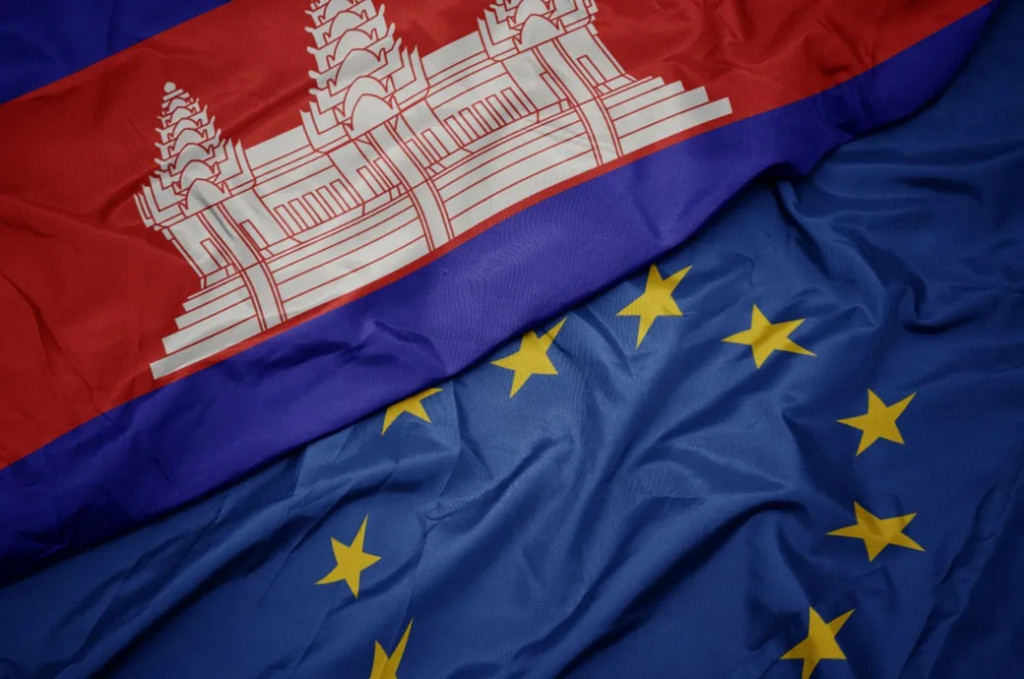
On Feb. 12, 2020, the European Commission partially suspended the Everything But Arms (EBA) trade regime granted to Cambodia because of civil and political rights violations by the country led by Hun Sen. Brussels' decision is virtually unprecedented, and, to date, Cambodia is the only country in the world affected by such a measure. Even post-Golpe Myanmar still enjoys EBA, despite many observers and NGOs calling on the Commission to take similar action against the Tatmadaw regime. The revocation of EBA is still in effect, and the European choice reveals that relations, political and commercial, between the bloc and the Asian country are not in good health. But, in the complex Southeast Asian chessboard, Brussels and Phnom Penh must watch the moves of other players and maintain a pragmatic approach if they do not want to end up in a corner.

To understand the scope of the Commission's measure, one must first know the characteristics of this trade policy instrument. EBA is one of the three Generalised Scheme of Preference (GSP) schemes and the most beneficial. The other two are the "simple" GSP and the GSP+. GSP schemes grant developing countries greater access to the EU market by substantially reducing duties on goods exported to the EU. EBA allows its beneficiaries to export almost any product, "except arms," to the EU without quotas and duties. The System has two objectives: first, to stimulate the economic development of partners; second, to promote respect for rights in these countries. Rights in a broad sense: human, political, labor and even environmental. This second purpose is achieved through a "conditionality" mechanism: a state can accede to GSP+ or EBA if it commits to ratifying and concretely implementing a number of international conventions; for example, those of the UN on human rights and the environment, or those of the International Labor Organization (ILO/ILO) on working conditions and trade union freedom. If the partner does not commit to this, or even moves in the opposite direction, the EU can suspend the preference regime, leading to an immediate increase in tariffs on goods coming from that country.

Before Cambodia, the EU had revoked the GSP and GSP+ regime a couple of times between 1997 and 2010, but never the EBA. Brussels' choice came in response to the Hun Sen regime's extremely harsh crackdown on the opposition, which has been particularly intense since 2017. After the judicial dissolution of the main opposition party, the National Salvation Party of Cambodia, in 2017, all its members were first expelled from every level of Cambodian institutions and then arrested, forced into exile, and in some cases even murdered under unclear circumstances. Before taking such a drastic decision, Brussels had indicated to Phnom Penh some urgent measures to be implemented to protect the opposition, receiving a flat refusal from the Cambodian government. Hun Sen had responded mockingly to Brussels, downplaying the importance of European support and confusing himself with the entire country: "Don't try to scare me. Don't threaten me. Don't threaten Cambodia by cutting development aid."

Indeed, EU-Cambodia trade relations, while good, are of relative importance to both sides. China (23.4 percent of trade), the U.S. (15.5 percent), Japan and the rest of ASEAN are closer partners than Phnom Penh, with the EU overall ranking fifth (9 percent). Nonetheless, Hun Sen's dismissive tone and affected confidence jar with the importance of the EU to the country's development and the actual concern of the Cambodian apparatus over the revocation of the EBA. In the months leading up to the decision, both Cambodian representatives and the lobbies of the country's most prominent industry groups (in particular, sportswear and bicycle companies) had gone out of their way to try to dissuade the Commission. And even among the European apparatus there were different perspectives on the line to take. Indeed, on the trade side, the EBA liberalizes international trade "one way," that is, it favors exports from Cambodia to the EU, but not vice versa. Some European companies benefit, however. Establishing production in Cambodia led to double savings: cheap labor and no duties. The suspension of the EBA therefore prompts such companies to invest elsewhere. Not so much out of dissent from Hun Sen's policies but, more prosaically, to keep "global supply chains efficient."

On a more purely political level, the situation becomes even more complicated. Brussels must hold together two opposing demands. On the one hand, to maintain the credibility of the GSP and, more generally, its sustainable development-oriented trade policy. Ignoring the alarming developments in Cambodia and continuing business as usual might seem hypocritical--though perhaps the EU should take similar steps toward other countries to remain consistent. Limited to the GSP, there are many cases of human rights violations, but all "controversial" countries have benefited from some flexibility on the European side. All except Cambodia. On the other hand, cutting trade ties and making harsh political condemnation explicit may not have the desired effect of promoting democratic values in the country but, on the contrary, may push it toward other "less demanding" partners that provide aid without conditionality. On this, too, Hun Sen was quite direct: "China has never given me any concerns and has never threatened or ordered Cambodia to do anything. Other partners should also not threaten Cambodia."

Even these words hide the real concerns of the Cambodian leadership. For Phnom Penh, depending too much on its unwieldy neighbor could become a problem, so it is better to follow a kind of "two-oven policy": taking advantage of China's (for now) unconditional aid, but also cooperating with the United States and its allies, so as to "diversify" sources of economic support and political legitimacy. In this sense, it is interesting to observe the Cambodian posture regarding the Russian-Ukrainian war, which is distinctly pro-Kyiv. This rapprochement with Washington could push liberal-democratic countries to turn a blind eye to human and political rights violations in the name of realpolitik. Pragmatism could also help restart a dialogue between the EU and Cambodia. For the time being, Brussels is holding the hard line, but it may reconcile with the Asian country in the future. Perhaps not in the name of rights, but pragmatism.

Ambassador Alessandro bids farewell to Vietnam

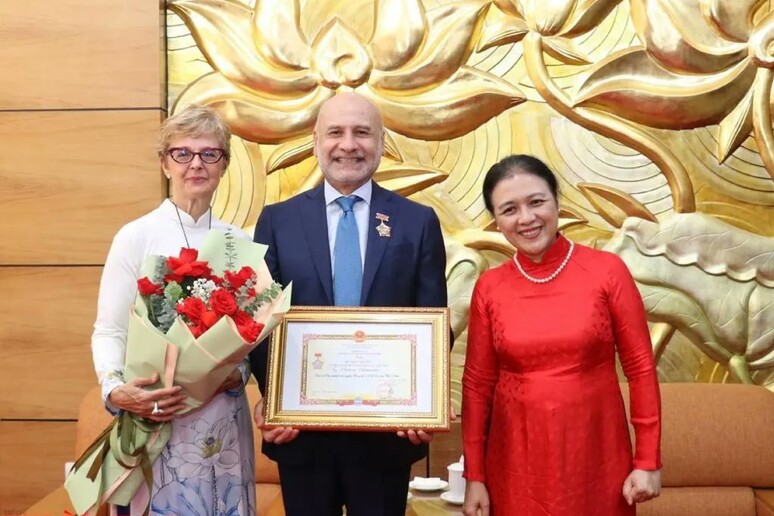
The Italian diplomat prepares to leave Hanoi. His farewell meetings as told by Vietnamese media

In Vietnam since November 2018, Italian Ambassador Antonio Alessandro paid two important farewell visits last week. Specifically to the Chairman of the Hanoi People's Committee, Tran Sy Thanh, and the Minister of Foreign Affairs, Bui Thanh Son. "Over the years, people-to-people exchanges have fostered mutual trust and understanding between Vietnam and Italy in general, and between Hanoi and Rome in particular, paving the way for extensive cooperation in the economic, trade and investment fields," said Tran Sy Thanh. As told by the Hanoi Times, he then expressed gratitude to the ambassador for his valuable insights and acknowledged his contribution to the overall development of bilateral relations between the two nations. With a commitment to promoting cooperation, Tran Sy Thanh assured that the local government will continue to facilitate the activities of the Italian Embassy in Hanoi by creating favorable conditions. The Vietnamese media reports that "during the meeting, Ambassador Antonio Alessandro expressed his deep gratitude and sense of belonging after serving in Vietnam for more than four years, saying he feels like a citizen of Hanoi." Alessandro went on to say that the Italian Embassy has received excellent support and cooperation from the Hanoi People's Committee, which has led to remarkable achievements in the various fields of cooperation between Vietnam and Italy, ranging from culture and society to economy, trade and tourism. Bilateral trade between Vietnam and Italy has seen positive growth, with Italian companies participating more and more actively in the Southeast Asian country's market. The Ambassador then anticipated new progress in relations between Vietnam, Hanoi and several Italian localities. Initiatives such as the Memorandum of Understanding on cooperation between Rome and Hanoi and Rome's bid to host EXPO 2030 offer promising prospects for greater cooperation. All this while just this year marks the 50th anniversary of the establishment of official diplomatic relations. Concluding his speech, the Hanoi Times reports, "Alexander said that although his term is now over, his affection and bond with Hanoi and Vietnam will last indefinitely." 

Thailand, the scenarios for the new government

As expected, Move Forward leader Pita Limjaroenrat failed to win enough senatorial votes to be named prime minister. For Thailand, a phase of great political uncertainty begins. Parliament goes back to vote on July 19: here are the scenarios for the formation of the new government

Article by Francesco Mattogno

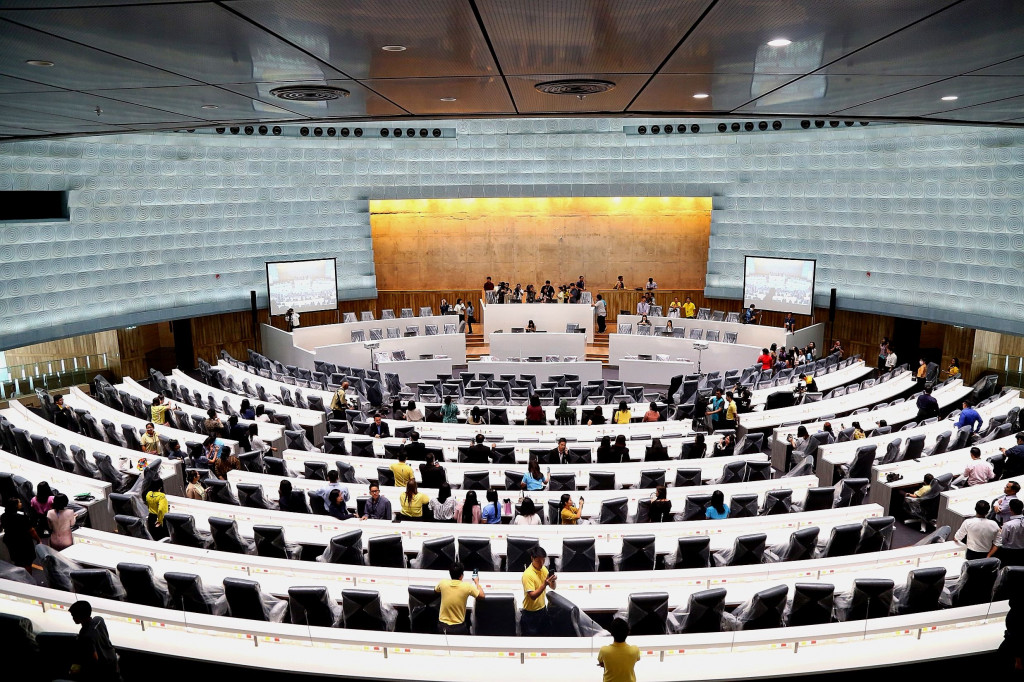
64 votes were needed, 13 came in. The first joint session of the Thai parliament to vote for a new prime minister closed Thursday night without the nomination of the only candidate in the running, Move Forward leader Pita Limjaroenrat. This was no surprise.

After winning the May elections, Move Forward formed a coalition of eight parties, grouping a total of 312 seats: more than enough to have a majority in the lower house of 500 MPs, but too few to elect the new government without the influence of the Senate. Until May 2024, in fact, the 250 senators appointed by the military have the constitutional power to participate in voting to appoint the prime minister, who then needs at least 376 votes to be elected (which became 375 on Wednesday following the resignation of a senator). A huge obstacle for those proposing to shake up the pro-monarchist, pro-conservative status quo that those same senators have been charged with protecting.

The parliamentary session

Beyond token optimism, it was clear from the eve of the vote that Pita would not have the numbers to leave the chamber as Thailand's 30th premier. Before the vote, parliamentarians were given about six hours for debate. The Move Forward-led coalition remained united and put forward Pita as its sole prime ministerial candidate, while the pro-conservative front parties did not put forward any aspirants for the role. The result was a single-issue session.

All the speeches focused on the legitimacy of Pita and his party to govern, with the Move Forward's willingness to amend the law on lese majesty, a proposal that conservative deputies and senators have repeatedly deemed dangerous to the country's stability, at the center. Another central issue in the opposition to the Orange leader has been the legal proceedings hanging over him. On Wednesday, the day before the vote, the Election Commission of Thailand asked the constitutional court to disqualify Pita as an MP, accusing him of having been aware of his ineligibility due to owning shares in the media company ITV (the constitution in such cases prohibits him from running for office).

According to the Move Forward member, this is a specious accusation--ITV has not operated since 2007--but in the meantime, the constitutional court could suspend him from parliament pending final judgment, which could also include his disqualification from political activity and a sentence of one to three years in prison. The court also accepted another case seeking the dissolution of Move Forward because of the party's intention to amend the law on lese majesty. Pita denounced the suspicious timing of the two proceedings, which provided an assist to senators to legitimize their refusal to vote for a suspect as prime minister.

The day ended with 324 votes in favor of Pita's nomination, 182 against, 199 abstentions. Those in favor included 311 coalition deputies (House Speaker Wan Muhammad Noor Matha abstained as usual) and 13 senators. More than 40 members of the Senate, however, did not show up in the chamber.

The main scenarios

On a formal level, there is no upper limit on the number of votes parliament can hold to appoint the prime minister. The next joint session has been set for July 19, and it is expected that a possible third session could be held as early as the 20th. On the political level, things are different. "I'm not giving up," Pita said on the sidelines of the vote. But the support he enjoys from coalition partners may be timed. Some members of Pheu Thai, the alliance's second-largest formation, said the party would support him for three votes, but then would have to think of an alternative path.

There are essentially four possible scenarios. The first envisions that -- net of legal proceedings -- the Move Forward leader will be able to find the 64 votes needed to be named premier. MPs from Bhumjaithai, the third largest party in the House (71 seats), have said they would vote for him should his party abandon the plan to amend the law on lese majesty. Which Move Forward has categorically denied. The second is to thus maintain the coalition but have Srettha Thavisin, a Pheu Thai candidate deemed more acceptable even than Paetongtarn Shinawatra herself, daughter of the party founder, elected as prime minister. However, there are those who argue that the establishment is unlikely to accept Move Forward even being part of the governing coalition.

There is thus the possibility of "betrayal." Pheu Thai could leave the coalition and form a government with conservative and pro-military forces, a choice that could have consequences both in terms of popular support for the party and law and order. It is believed that in the event of Move Forward's ouster from the executive, a series of mass protests by its supporters could be triggered. Very likely even in the case of the last scenario, that of the formation of a very weak minority conservative government.

The other possibilities

There are other possibilities, however. A more extreme and complicated one is to extend to the bitter end the joint parliamentary sessions for voting for the premier until the Senate's term expires in May 2024. Unlikely also because it would worsen Thailand's already highly uncertain political and economic situation. Therefore, the pro-democracy coalition would be considering an alternative solution.

As reported by the Thai Enquirer, on Friday Thai afternoon Move Forward plans to propose to the House the amendment of Article 272 of the constitution, the one that allows the Senate to vote on the appointment of the prime minister. The proposal would pass with the support of half of the lower house deputies (250) and a third of the senators (84). According to Piyabutr Saengkanokkul, one of the leaders of the progressive movement, several of the senators who abstained from Thursday's vote could accept the amendment, which could then take effect within four weeks. It remains a complicated scenario. Meanwhile, the interim prime minister remains former coup general Prayut Chan-o-cha, in power since the 2014 coup. Prayut has announced his intention to retire from politics, but if the appointment of a new premier drags on for a long time his interim government would end up having to make important decisions, such as those regarding the budget for 2024 and the army and police reshuffle. Political instability has also always been a pretext in Thailand for "restoring order" through a coup. Hypotheses that no observer of Thai affairs ever feels like ruling out entirely.

Barbie & co.'s problems with maps in Vietnam

Depicting the South China Sea is a tricky thing, given the territorial disputes between some ASEAN countries and China. And it sometimes happens that movies or bands have problems 

It may be a "childish doodle," as Warner Bros. called it, but enough is enough. The map that appears behind Barbie's back in a scene in the trailer was enough to have the film removed from Vietnamese theaters. And it is not even nine features, but eight. Their location next to a parallelepiped sketched with the words "Asia" conveys an unmistakable image: that is the "nine-dash line," the demarcation line of those territories in the South China Sea that China claims as its own. 

First the posters disappeared from theaters, then on Monday, June 26, came the final news: Greta Gerwig's film will not be released "because of some scenes depicting the nine-dash line map, which is considered a violation of Vietnam's territorial sovereignty." Word from the National Council for the Evaluation and Classification of Films. Social media also favored the government perspective: regretful but infuriated with the producers, Vietnamese netizens were equally offended by the pro-China map.

Manila also considered the option of outright censorship. "The map legitimizes Chinese claims, which no government in the world supports" and is "offensive to all" countries in the region, argues military analyst Jose Antonio Custodio. These are smaller markets, but not so indifferent, explains Hollywood Reporter: a Hollywood cult in the Philippines and Vietnam can add between five and ten million dollars to Warner Bros. budget. Quite a risk if national pride starts infecting neighboring countries. The Asian archipelago, moreover, spearheaded the 2016 petition to the international tribunal in The Hague denouncing Chinese incursions and demanding compliance with the United Nations Convention on the Law of the Sea (UNCLOS).

Pop nationalism

The same "oversight" in 2019 cost Vietnamese film distributor CJ CGV as much as $170 in fines: it had marketed The Little Yeti, a DreamWorks-signed cartoon that ended up in the crosshairs of the Philippines, Vietnam, and Malaysia for the same reason. 2019, after all, has been one of the most tense years in the South China Sea, caused by the operations of the Chinese vessel Haiyang Dizhi 8 around the Spratly Islands.

La stessa “svista” nel 2019 è costata ben 170 dollari di multa al distributore di film vietnamita CJ CGV: aveva commercializzato Il piccolo Yeti, un cartone animato firmato DreamWorks finito nel mirino di Filippine, Vietnam e Malesia per la stessa ragione. Il 2019, d’altronde, è stato uno degli anni di maggiore tensione nel Mar cinese meridionale, causata dalle operazioni del vascello cinese Haiyang Dizhi 8 nei dintorni delle isole Spratly. 

The nine-dash line, which takes up about 90 percent of the three million square kilometers of water that bathes mainland Southeast Asia, has infuriated the Philippine government with Netflix over its appearance in some scenes of the Australian series Pine Gap. So much so that the streaming giant proceeded with their removal from the platform.

On the other hand, critics say, there would be an ongoing process of self-censorship and condescension toward China by the cultural industry giants. Between multimillion-dollar investments in U.S. production companies coming in from the PRC and the obvious preponderance of the Chinese market - the second largest in the world - here even Hollywood would be prone to the subtleties of Chinese soft power.

In 2016, a bipartisan group of sixteen members of Congress had taken it upon themselves to expose Chinese business around the U.S. entertainment industry, gaining the consensus of the Committee on Foreign Investment in the United States (CFIUS). In ASEAN countries, at least those most aggressive against Chinese incursions into claimed areas, the process is less complicated: the government takes care of it directly.

Not just cinema

The rhetorical battle is not limited to the cinematic sphere. Initially denounced on social media, the controversial graphics on the website of the organizers of the Vietnamese leg of the k-pop group Blackpink generated the same boycott threats. The company, iMe Entertainment Group Asia, soon responded to the Culture Ministry's demands by promising to remove the tour map. It explained in a statement, "The map does not specifically represent the territory of any country, we are aware of and respect the sovereignty and culture of each country."

Hanoi also did not relent when it came to validating entry visas into the country on new Chinese passports. In 2012, these passports clearly showed the map that since 1949 would justify the historical belonging of the South China Sea territories to China. And Vietnam then asked to issue separate documents instead of stamping the dedicated pages.

In countries such as Vietnam, culture is one of the outlets granted by the Party. This was the case with the wave of demonstrations in 2011 and 2014 that brought masses of angry citizens to the streets of major Vietnamese cities, all in protest of Chinese manoeuvres in the claimed areas of Hoàng Sa (Paracelsus Islands) and Trường Sa (Spratly Islands). 

Bringing down the language of nationalism to the culture industry could allow this too. What better than a global cinematic success to ignite the flame of public participation where few-if any-are the venues for dissent? A process that occurs, by contrast, in China, where geographic definitions on a T-shirt can trigger a brand ban.

Philosopher Alfred Korzybski argued that "the map is not the territory," but an ideological construct. For Asian countries bordering the South China Sea, the map is something more: an always necessary history, and never a "doodle."

The depths of diplomacy

Among the most coveted projects is the Southeast Asia-Middle East-Western Europe 6, or SeaMeWe-6, which connects France to Singapore, touching a dozen other countries. A project at the center of competition between the United States and China, it will place Singapore even more at the heart of world diplomacy

By Chiara Suprani

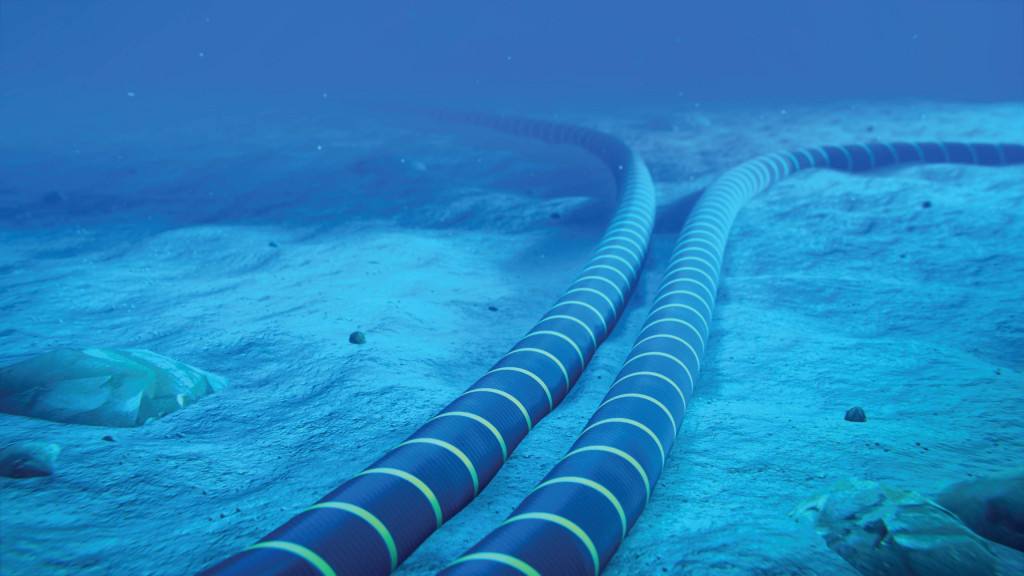
Among the means that countries take to direct their "economic diplomacy," there is one less popular than semiconductors, but just as central: it lies underwater, connecting continents with "only" the power of a cable. These are undersea telecommunications cable networks, which have become critical infrastructure over the years for digital economy, international data traffic but also for logistics. Italy, too, is planning its own submarine cable: it is called Unitirreno, and it connects Genoa to Mazara Del Vallo, providing access to a "carrier-neutral" data center that does not belong to any telecommunications company. Submarine cables make connections faster, dilute data traffic, enable better telecommunications and digital phases of countless economic sectors. And a cable is as much a part of the network as it is a node.

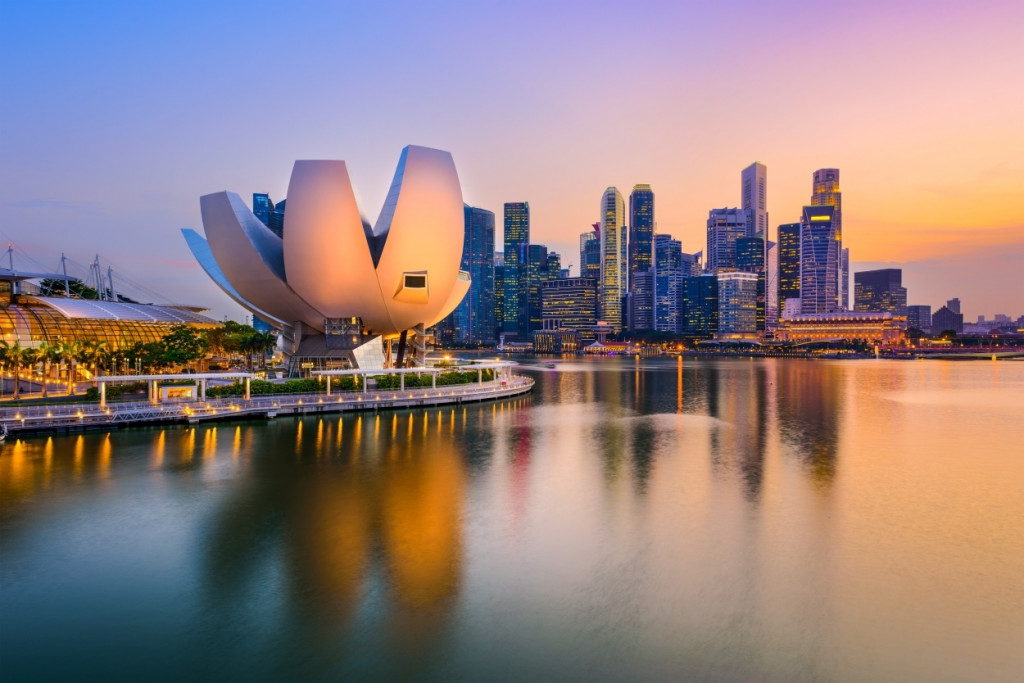
Among those nodes is Singapore, which has 25 operational submarine cables under its belt, making it the largest underwater Ethernet hub in the region. And in addition to the already planned 14 future projects, the city-state will double the number of cable attachment points in the coming years through billions of dollars of investments.

Companies such as Meta, Google along with countries such as the Quads, which are Australia, Japan, India and the United States have set their eyes on Singapore. The companies are investing in projects called Echo and Bifrost, both of which will be finished next year and Echo will connect Singapore to the United States for the first time, directly; the Quads have signed a new agreement to increase undersea Ethernet cables in the Indo-Pacific.

And as critical infrastructure, their fragility has not gone unnoticed either. Submarine ethernet cables have often been the subjects and victims of diplomatic disputes between countries: for Wired, the global network of undersea cables makes up most of the skeleton of the internet nowadays, irreplaceable even by Elon Musk's famous Starlink project. As the number of undersea cables has increased, hubs became at the same time "choke points" or breaking points, as in the case of Egypt from which 17 percent of all the world's internet traffic passes. Similar could be the fate of Singapore, which will have to ensure uninterrupted data traffic and be a reliable resource. The city-state will have to develop a disaster mitigation response plan, disaster such as those that affected the Solomon Islands in 2018, the Federated States of Micronesia in 2021 and the Matsu Islands in February this year. Among the most coveted projects is the Southeast Asia-Middle East-Western Europe 6, or SeaMeWe-6, which connects France to Singapore, touching a dozen other countries. A project at the center of competition between the United States and China, it will place Singapore even more at the heart of world diplomacy.

ASEAN will lead the next decade of global trade

Southeast Asia is set to become a major growth center in the coming years. This is supported by a new report from Standard Chartered Bank

"Global trade is increasingly shifting toward Asia as high-growth corridors emerge within the region and to new markets in Africa and the Middle East. The bloc of Southeast Asian countries that are part of ASEAN is obviously at the top of the list, with trade among the bloc's member states set to accelerate to nearly 9 percent annually over the next decade." Michael Spiegel, global head of Transaction Banking at Standard Chartered Bank, strongly argues this in a commentary published in the Business Times. "While these trends signal great opportunities, businesses are also facing a polycrisis, or a set of interdependent challenges, from rising geopolitical tensions, inflation and energy prices to the increasingly urgent need to address climate risks," Spiegel writes. According to the Standard Chartered Bank expert, "to succeed, companies must act now, connecting to new markets to diversify both sourcing and production to achieve more resilient supply chains. Sustainability is increasingly an imperative for both investors and consumers, making environmental, social and governance (ESG) compliance more urgent than ever, not only for corporations but also for their suppliers." Spiegel argues that "companies must balance growth objectives with resilient and sustainable supply chains. They need to identify and connect to growth opportunities, then execute a sustainable and resilient growth plan." The Standard Chartered Bank expert concludes by asking a precise question to which he proposes an equally precise answer: "So where will the growth hubs of the future be? We believe they will be in Asia, Africa and the Middle East, which are set to propel global exports from $21 trillion to $32.6 trillion by 2030, according to our new Standard Chartered Bank Future of Trade report."

Recently active members
Foto del profilo di Alessio
Foto del profilo di Monika
Foto del profilo di Gabriel
Foto del profilo di Elena
Foto del profilo di Lorenzo
Foto del profilo di Alessandro
Foto del profilo di Cristina
Foto del profilo di Rocco
Foto del profilo di Clara Lomonaco
Foto del profilo di Redazione
Foto del profilo di Davide Gugliuzza
Foto del profilo di Anna Affranio
Foto del profilo di Ilaria Canali
Foto del profilo di Nicolò
Foto del profilo di Angelo Cangero
Who is online
There are no users currently online
Members
  • Foto del profilo di Alessio
    Active 3 ore, 22 minuti fa
  • Foto del profilo di Monika
    Active 3 giorni, 16 ore fa
  • Foto del profilo di Gabriel
    Active 3 settimane, 4 giorni fa
  • Foto del profilo di Elena
    Active 1 anno, 4 mesi fa
  • Foto del profilo di Lorenzo
    Active 2 years, 6 mesi fa