Can Singapore overtake Hong Kong?

The dispute between Beijing and Hong Kong is driving foreign investors increasingly to Singapore

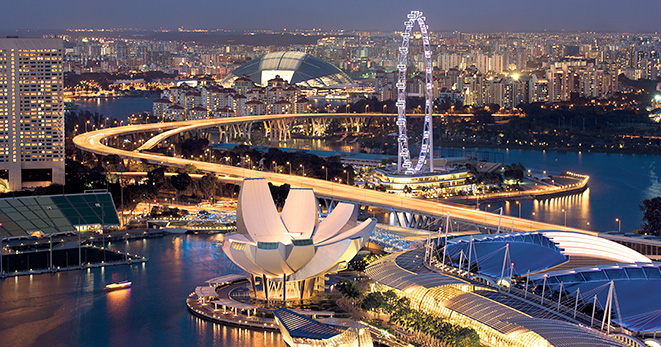
In the last years, Beijing’s pressure on Hong Kong’s domestic politics has generated clear implications not just with regards to the political-administrative aspect of the island, but also affecting indirectly its economy. The riots in Hong Kong have warned foreign investors that they would begin to increasingly redirect their investments to Singapore, the second largest financial hub in Southeast Asia.

The triggering cause of this trend is precisely the political influence of China on Hong Kong: for the city-State, in fact, the definition of "one State, two systems", the one that was adopted in 1997, the year in which the United Kingdom gave back Hong Kong's sovereignty to the People's Republic of China, is fading away.

Last month the Heritage Foundation, an American think tank that deals with analyzing the data of all the countries of the world drawing up their economic characteristics, has decided to remove Hong Kong from the ranking and its data now are no longer available on the association's website: a severe blow for Hong Kong, which, from 1995 to 2019, was considered by the American foundation the country with the freest economy in the world, the perfect place for foreign investors.

The decision comes from the fact that Hong Kong, from a political-bureaucratic point of view, is no longer considered autonomous: the association has therefore decided to combine its data with China, ranked 107th among the freest economies. In light of these developments, Singapore smiles: having overtaken Hong Kong last year, today the small State continues to hold the top spot on the list with a score of 89.7, far ahead of New Zealand by almost six points. 

If already in 2019 there were the first signs of an increasingly marked economic crisis for Hong Kong, the draconian law on national security, promulgated by Beijing last July, has caused some companies to run for cover towards the shores of Singapore. Deutsche Bank for example, stated its intention to move the office of the new CEO of the Asian area to Singapore, no longer considering Hong Kong a safe place. The new security law would affect two of the main pillars on which the strength and attractiveness of Hong Kong’s economy was based: the protection of property rights and the rule of law. For these reasons, another phenomenon that has been marked in the last two years is the decision of many companies to rely on arbitrary judges in other cities such as Singapore or London, fearing the lack of transparency of the new Hong Kong bureaucracy. 

Even for business expansion, companies are looking more towards Singapore: according to a Financial Times survey, some credit companies and banks would show more interest in expanding their branches in Singapore rather than Hong Kong: on Linkedin, jobs position opened by UBS and JP Morgan in Singapore are eight times than those in Hong Kong, while Credit Suisse and Goldman Sachs have doubled their advertising campaign in Singapore.

However, not all the analysts agree with the decline of Hong Kong: the strong interest of tycoon and Chinese companies are giving new impetus to the island’s economy.

However, with its excellent results in terms of protection of property rights and government integrity, Singapore has the opportunity to establish itself as the main hub for international investments in the Southeast Asia. 

By Alberto Botto

5 years in 1: The new ASEAN e-commerce

Not only China: e-commerce is also gaining momentum in ASEAN, with a specific emphasis on everyday consumables.

In the last months we witnessed the gradual disappearance of specific industrial sectors, while others have experienced rocketing growth. E-commerce is clearly the best example of success, and specifically e-commerce in Asia.

McKinsey has found that 2020 has seen two examples of international successful companies: the ones that focus on Asia (+9%) and that massively invest on enhanced digital infrastructures and commerce platforms (+76%).

China has been, for years, the leading actor in this sector. In 2020 Chinese e-commerce grew to a record $2.090 billion, up 26% from the previous year. Total active customers are now 900 million over a total population of 1,4 billion people. However, it is important to shed a light on the two underlying changes that Chinese e-commerce has seen in the last months.

First, Chinese are still not allowed to leave the country out of necessity matters, and they cannot access the most important global commercial and fashion hubs. This has been the end of the so called ‘shopping tourism’, which has brought nationals to purchase online and from their homes. Now, 73% of retail purchases are online, versus 35% of 2019, the trend to endure up to 50% in 2025. Second, Gen Z (the ones born after 1995) are increasingly gaining prominence in purchases, especially the ones living in lower tier cities.

Gen Zs and Millennials account for roughly 300 million consumers, and their presence is literally reshaping the e-commerce landscape by emphasizing the importance of uniqueness and omnichannel experiences.

Although less skyrocketing, ASEAN has also witnessed a historical evolution in its e-commerce industry. Studies have found that the e-conomy in the region has grown five times more than in a business-as-usual year before 2020.

Users grew from 360 to 400 million, while active consumers have grown 33%. If keeping this rate, ASEAN e-commerce market will value $300 billion in 2025. 

The key for this growth has been massive investments in digital infrastructure and architecture and traditional business model innovation, which have all spurred the way for new industries to grow in the long term. In particular, ICTs development and education have also been crucial in successfully facing Covid-19 related challenges. Moreover, the growth of digital conglomerates, together with innovation in digital payments methods, have allowed millions of retailers to access international marketplaces. Similar to the Chinese case, most of the new consumers are young, live in rural or less important urban areas, and are highly sensitive for customization, peer-to-peer confrontation and quality omnichannel integration. Notably, 94% of Southeast Asians internet users will continue to purchase online after the pandemic has ended, a remarkable share even when compared with China (around 40%). 

Though similar to other global ecosystems, ASEAN e-commerce is fundamentally different, due to an intrinsic characteristic.

Indeed, before 2020 the great majority of retail purchases were made offline: like others, ASEAN economies are traditionally ‘communal’, meaning that physical daily contact is an inseparable part of social and economic structures. In this sense, the region has pioneered a new approach to digital commerce, centered on exchange of consumable goods and food. Online purchases of groceries and food deliveries has increased 35%, reaching $6 billion, one of the most consistent increases. However, here the key is that online Asian users are willing to purchase high-quality consumables as well as best-in-class groceries.

These numbers highlight a unique chance for Italy and for Made in Italy products, which have historically been able to represent quality, focus on style and on personality in everyday life, being it with fashion products or food. 

Asian e-commerce has been the key for companies’ prosperous growth in 2020 but will by all chances be also the key for growth for years to come: Italy, if takes it on time, can not only be an accelerator of this commercial shift, but also a global leader promoting a new cross-national e-conomy model.

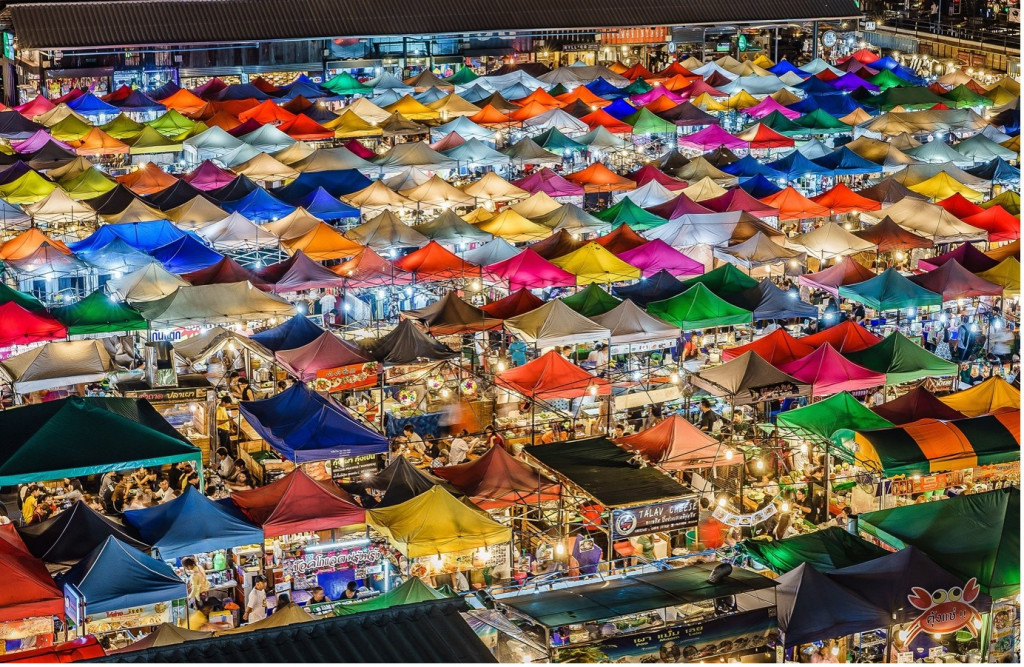
Lack of tourism in Thailand causes baht depreciation

Public intervention does not seem to be enough to rescue the national economy from the pandemic

“A perfect storm is engulfing Thailand’s baht and the one group of people who can save it are stuck in lockdown, thousands of kilometers from the arrivals lounges of Bangkok, Phuket and Chiang Mai.” A un articolo di Bloomberg article opens in these terms, noticing how the absence of tourists in Thailand translated into a depreciation of the national currency. Indeed according to the author, baht is currently the worst performing currency in Asian emerging markets. Several factors contributed to this decline: deficit in the balance of payments, the contextual increase of the dollar and the seasonal repatriation of dividends by Japanese investors. But the dire outlook on tourism is the real weak link in the national recovery.

In general, emerging economies of Southeast Asia are deeply embedded in the webs of globalization, which is why the consequences of the Covid-19 crisis were quickly transmitted from one country to another. The entire region based its economic growth on exports, attraction of foreign direct investments and global value chains - hardly hit by the pandemic. The contraction in global trade has strongly affected the economic stability of these countries, even though ASEAN maintained positive growth rates in 2020. In short, the picture is not the brightest: a series of systemic contributing causes afflict the region.

As argued by Victoria Kwakwa, Vice President of the World Bank for East Asia and the Pacific, political and health performances of ASEAN countries are commendable, but this is not enough for countries that heavily rely on the one sector that cannot be digitized: tourism.

ASEAN has pledged to do everything in its power to remedy the situation. It promoted the Development Framework, the 2020-2030 Work Plan and the White Paper for the implementation of intra-regional and international tourism. But in 2019 in Thailand tourism-driven services contributed to the 62% balance of payments surplus, and the situation has dramatically worsened since then. The current account deficit recorded in the first quarter of 2021 overwhelmed the Thai baht, which fell by 3% in March. According to economist Prakash Sakpal, an Asia’s expert, the current deficit of $ 1.7 billion in the first two months of 2021 compared with the surplus of $ 8.8 billion in the same months of 2020 clearly describes the situation. The Bank of Thailand hoped that a depreciation could have revived the economy, making Thai exports more competitive and favoring tourism. However, while most ASEAN countries have experienced a vigorous recovery in exports since mid-2020, Thailand has maintained a negative trend, declining 1.2% year-on-year in February last year.

According to Forbes, the country hopes that easing restrictions on intra-regional tourism will encourage people to travel more. The Center for Economic Situation Administration is considering welcoming vaccinated visitors without quarantining them for some destinations, starting in July 2021. However, different variants of Covid-19 could further slow the recovery of tourism, and perhaps the recovery for the whole country will be slower than expected. A rapid distribution of vaccines is crucial in this sense, especially with regard to international tourism - which is why the slowness of Europe, the third country of origin of tourists visiting Thailand after East Asia and Southeast Asia, does not bode well.

Latest update from Myanmar

The death toll continues to rise and EU and US sanctions are not enough to stop the escalation of violence in Myanmar.

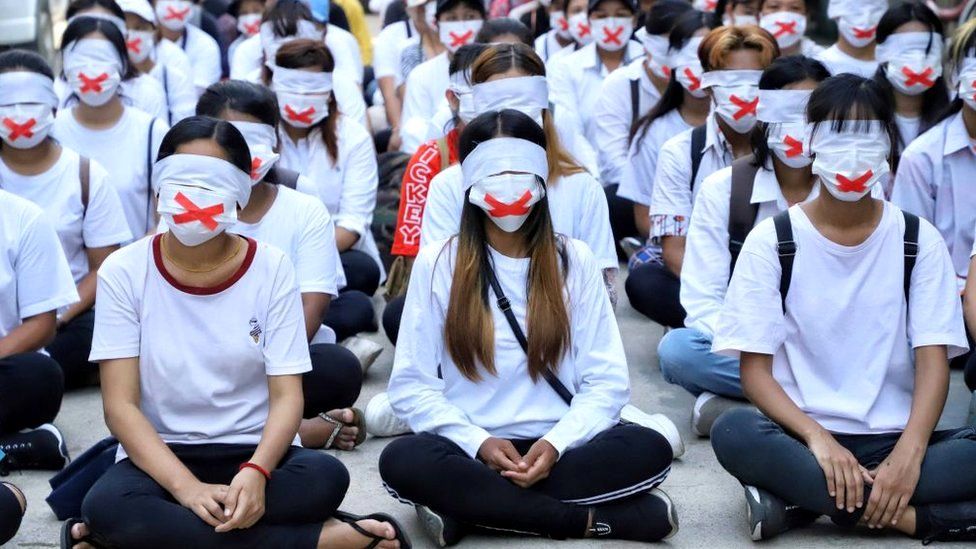
For the past two months Myanmar has been the scene of terrible violence. On February 1st, the armed forces carried out a coup, arresting de facto leader Aung San Suu Kyi and some leaders of the National League for Democracy, the majority government and winner of the the last election in November 2020. Power is now in the hands of General Min Aung Hlaing, while Suu Kyi is accused of fraud and irregularities. 

The Assistance Association for Political Prisoners said that since the start of the coup in Myanmar, at least 521 civilians have been killed during the protests, including 141 people only on Saturday 29 March, the most tragic day so far. The situation is getting worse and the use of lethal force against civilians by the army and security forces shows no sign of stopping.

The National Armed Forces Day became another bloodbath with over 100 deaths, including several children. The army continued to crack down on civilians with gunfire, while military parades were held in Naypyidaw to commemorate resistance against Japanese occupation during World War II. The unprecedented violence of the “day of shame” for the Myanmar rmy has in fact triggered various reactions from the international community. Tom Andrews, UN special rapporteur for human rights in Myanmar, called for the urgency of an international summit if the Security Council could not act. As member states, Russia and China could have the right of veto over any proposed intervention aimed at restoring democracy. Both nations featured in the military celebration, along with military representatives from Bangladesh, India, Laos, Pakistan, Thailand and Vietnam; Moscow was the only country which sent the Deputy Minister of Defense. The response of the Defence Chiefs from 12 countries, including Italy, was also timely. They signed a joint declaration condemning the use of lethal force by the Burmese army against unarmed people, urging an end to the attacks and the compliance with international standards of conduct.

In recent weeks heavy disapproval had already arrived from the Western front. On February 10, President Biden announced the imposition of sanctions to prevent Burmese generals from accessing the fund they hold in the United States, including freezing US assets that benefit the Burmese government, while maintaining support for health care and civil society groups. In coordination with the US, on March 22 the EU imposed sanctions on 11 people linked to the coup. The Council of Europe enacted a travel ban and an asset freeze, along with previous restrictions relating to the arms embargo and the export of communications monitoring equipment. EU sanctions hit Burmese junta chief Min Aung Hlain, nine other senior military officers and the head of the electoral commission. This was the most concrete and broadest act of Europe in underlining its unshakable support for the democratic transition in Myanmar. After the horrific violence of the last weekend, the US considered additional measures and ordered the suspension of trade agreements with Myanmar, as well as the withdrawal of non-essential embassy staff. The new actions target the personal assets of Min Aung Hlaing's family, including state-owned enterprises or their subsidiaries, and military-related conglomerates.

In relation to the economic sphere, many analysts believe that Myanmar may be able to face Western economic sanctions, given that most of the investments come from Asia, with Singapore, China and Hong Kong in the lead. However, a significant decline in FDI is expected over the next two years due to social unrest and political uncertainty and the impact of sanctions, but for now the impact on trade and exports may remain modest given the likely amortization from other markets, especially Thailand and China.

L’ambiziosa transizione tecnologica del Vietnam

Il Vietnam lancia la Strategia nazionale sull’intelligenza artificiale, inaugurando una promettente transizione tecnologica che conferma il suo ruolo di punta tra le economie ASEAN

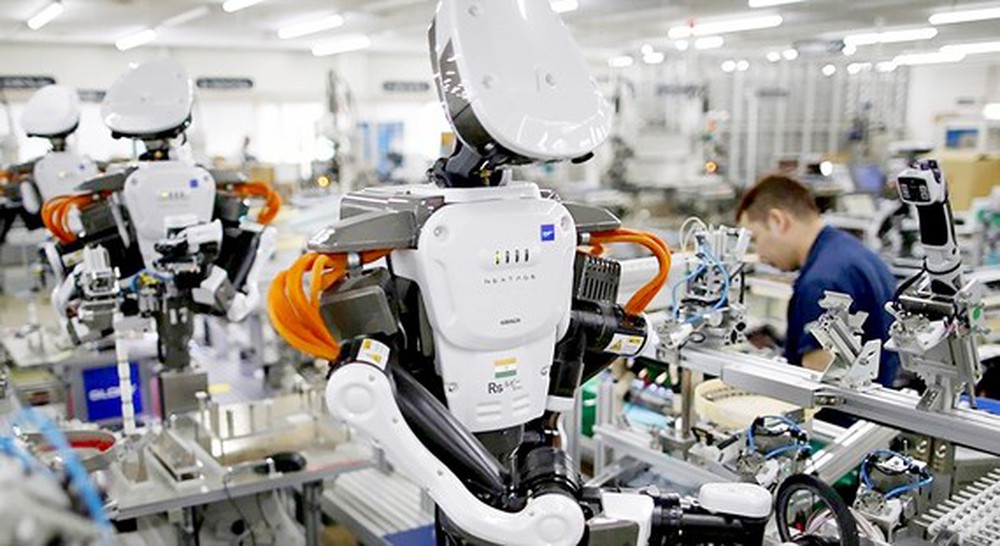
Il Primo Ministro vietnamita Nguyễn Xuân Phúc ha emanato la Strategia Nazionale su Ricerca, Sviluppo e Applicazione dell’Intelligenza Artificiale (AI) per il 2030. Dopo le straordinarie prestazioni nell’affrontare la crisi sanitaria dovuta alla pandemia, il Vietnam rilancia il suo ruolo nel Sud-Est asiatico, determinato a divenire centro propulsore per l’innovazione e lo sviluppo dell’intelligenza artificiale. Il piano è stato lanciato il 17 marzo 2021 in vista della convocazione dell’Assemblea nazionale – i cui lavori si tengono dal 24 marzo all’8 aprile 2021. L’Assemblea, la prima dopo il 2016, ha l’obiettivo di raccogliere i risultati positivi degli ultimi anni che hanno visto il Vietnam attestarsi tra le economie asiatiche più performanti del 2020, e di rilanciare il programma di sviluppo per i prossimi cinque anni.

La Strategia è infatti in linea con i programmi di modernizzazione annunciati nell’ambito del XIII Congresso del Partito Comunista vietnamita. L’ambizioso programma di sviluppo verrà promosso all’insegna del motto “solidarietà, democrazia, disciplina, creatività e sviluppo”, e la sua implementazione dovrebbe guidare la rotta del Vietnam verso la modernizzazione e la digitalizzazione prefigurate dalla nuova leadership. La promozione del piano Industria 4.0 rientra infatti in un progetto di ampio respiro che coniuga questioni di sviluppo socio-economico e sicurezza ad aspirazioni strategiche di rilevanza globale, oltre che regionale. 

Dal punto di vista della politica interna, l’intelligenza artificiale è considerata, a ragione, una tecnologia chiave per l’aumento della produttività del settore pubblico e per il rafforzamento della sicurezza nazionale. La Strategia si declina perciò in due ordini di obiettivi, quelli di breve termine da implementarsi entro il 2025 e quelli di medio termine per il 2030, anno di celebrazione del centenario del Partito Comunista del Vietnam. La roadmap prevede, tra le altre misure, l’affermazione di 10 marchi e servizi di AI entro il 2030 e la costruzione di tre centri di archiviazione di big data nazionali per uniformare l’accesso di aziende al computing e ad altre prestazioni. Inoltre, nel realizzare questo ambizioso programma, la leadership vietnamita delega a ciascun ministero l’implementazione di varie misure, che spaziano dalle responsabilità tecniche affidate al Ministero della Scienza e della Tecnologia, a quelle riguardanti le risorse umane delegate al Ministero dell’Istruzione e al Ministero dell’Informazione e della Comunicazione: ciascuna articolazione statale trova il proprio posto nella dettagliata Strategia 2030.Quello dell’AI è un settore dall’enorme potenziale per il Vietnam. Secondo la Banca Mondiale, grazie alla sua profonda integrazione con l’economia globalizzata, il Paese ha dimostrato una straordinaria resilienza alle conseguenze economiche del Covid-19, che hanno lasciato in ginocchio molte altre economie internazionali. E’ stato uno dei pochi Paesi a non subire una recessione, avendo vantato un tasso di crescita del PIL che è oscillato tra il 2% e il 3% nel 2020, e per questo è tutt’ora uno dei mercati emergenti più promettenti nel Sud-Est asiatico. Questo rinnovato impegno nel settore dell’intelligenza artificiale conferma il ruolo centrale del Vietnam tra le economie ASEAN, e dimostra come il Paese – la cui leadership ha dato priorità a crescita economica e stabilità –  abbia anche per investitori e imprenditori stranieri un grande potenziale in attesa di essere sviluppato.

The Philippines, Far East of Far West?

By easing the strict rules in foreign direct investments, the Philippine market opens up to foreign investors

The Philippines represents a very special case in the ASEAN landscape. The archipelago, located in the center of the China Sea, is geographically referred to as "part of the Far East". However, due to its history and origins, it would be more appropriate to call it the "Far West". In fact, the Philippines, in addition to being one of the strongholds against Chinese expansionism in the area and one of the barrier bases set by the US in the Pacific, continue to be one of the most important pawns of Western economic policy in Southeast Asia. 

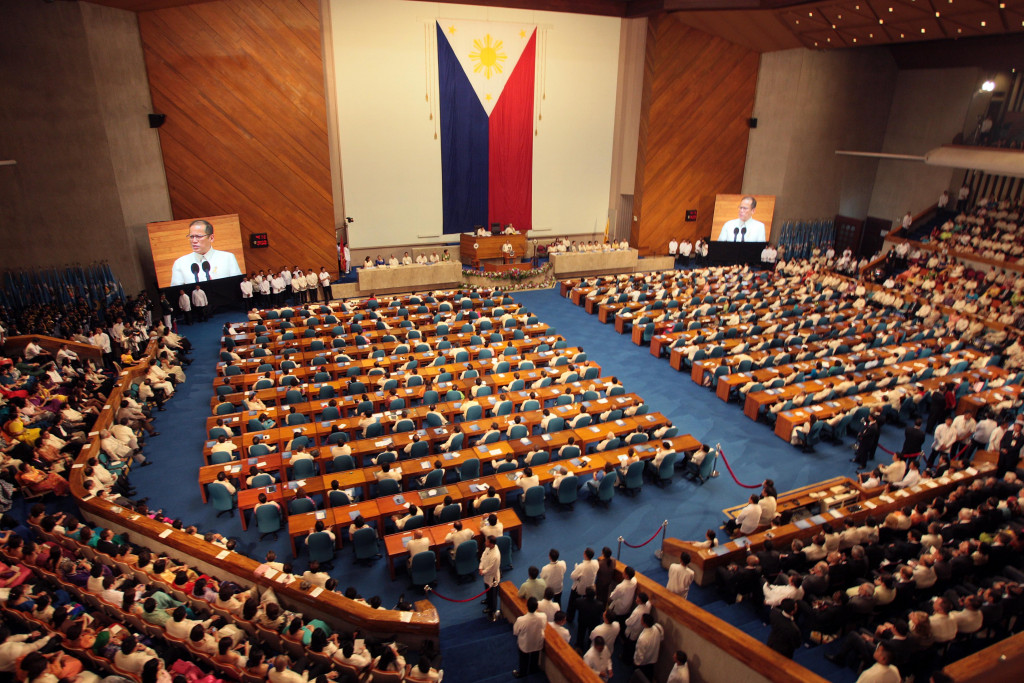
The dichotomy between East and West is also reflected in domestic politics. In recent years, President Rodrigo Duterte has tried to open up the domestic market more and more to Western companies, pushing for a relaxation of the strict rules on foreign direct investment, considered by the OECD, in a 2019 report, among the most restrictive of their kind in all of Southeast Asia.

The obstacles to foreign investment in the archipelago have created, indeed, a market dominated in various sectors by large local conglomerates. That is why the Philippine Senate is now ready to adopt, by the end of May, a legislation amending three laws - the Foreign Investment Law, the Retail Trade Liberalization Law and the Public Services Law - approved by the House of Representatives last year.

Currently, under its Constitution and the laws in place, the Philippines remain a country with a number of restrictions on foreign investments, in addition to a series of restrictions on other areas, such as private property or employment. Depending on the business sector, the restrictions on foreign investments can be very severe, in particular for companies with share capital of less than 200,000 USD. Furthermore, for some professions, the exercise of them by a foreigner is prohibited or is made very difficult. A foreigner or a company with foreign capital cannot own more than 40% of a land. The share of corporations that can be held by foreigners generally ranges from 0% to 40%, depending on the sector in question, with some exceptions if the investment exceeds certain thresholds. Full private ownership is allowed to foreigners only in retail, but heavy restrictions are imposed on paid-up capital and investments, discouraging entry. Foreign companies usually enter the Philippine market through joint ventures with local partners or franchise chains, but system’s inefficiencies often emerge due to the lack of management control and the greater protection usually enjoyed by local competitors, further discouraging the foreign intervention. 

Not surprisingly, according to the Central Bank of the Philippines, net foreign direct investment in the country fell to $ 6.5 billion in 2020, marking the third consecutive year of decline. To counter the trend, in June 2020, the Philippine government announced the approval of 12 new economic zones, which will be managed by the Philippine Economic Zones Authority,, the largest investment agency in the country which has the task of assisting foreign investors and facilitate their business operations in the country, with the power to grant tax and non-tax incentives. However, under the Corporate Recovery and Tax Incentives for Enterprises Act (CREAT), considered the largest fiscal stimulus program in the country's history, the government will immediately reduce the corporate income tax rate from 30% to 25% and the incentives (such as tax breaks, logistical support and facilitated customs procedures) will be decided by the President on the advice of the Fiscal Incentives Review Board (FIRB). Opening the Philippine market to foreign investors and reducing bureaucratic constraints related to business are therefore among the top priorities of the Duterte government. A goal that now appears close, after the failed attempts of the previous administrations and that will move the axis of the Philippines even more towards the West.

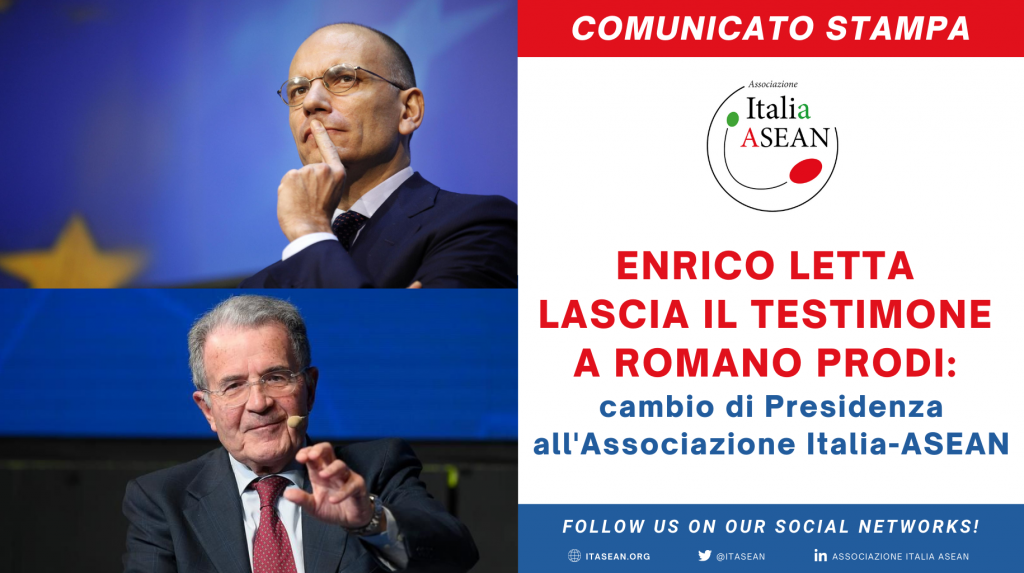
ENRICO LETTA LASCIA IL TESTIMONE A ROMANO PRODI: cambio di Presidenza all’Associazione Italia-ASEAN

PRESS RELEASE

ASEAN's approved Prof. Romano Prodi sostituisce Enrico Letta alla presidenza dell’Associazione Italia-ASEAN. L’ex Presidente della Commissione europea ha accettato l’invito del neosegretario del Partito Democratico a guidare l’associazione da lui fondata nel 2015 per favorire e stimolare le relazioni tra l’Italia e i 10 paesi del Sudest asiatico, nel quadro delle relazioni tra Unione Europea e ASEAN.

Nel suo commiato, il presidente uscente Enrico Letta ha sottolineato che “in questi sei anni di attività, il livello di relazioni politiche ed economiche è cresciuto grazie al lavoro dell’associazione, che si è sviluppato dalle intuizioni di Francesco Merloni – alla guida di uno dei primi gruppi industriali italiani a guardare all’Asia sudorientale – e del Presidente della Repubblica Mattarella, primo capo di stato europeo a visitare il Segretario Generale dell’ASEAN”.

Enrico Letta nel motivare la scelta di Romano Prodi – con esperienze di governo italiane ed europee – ha ringraziato i vice presidenti Romeo Orlandi e Michelangelo Pipan, il tesoriere Oliver Galea, il direttore Valerio Bordonaro e la Segretario Generale Alessia Mosca, che assumerà la carica di Vice Presidente esecutivo.

Il professor Prodi ha accettato con entusiasmo spingendo sulla necessità dell’Italia di rafforzare quelle strutture che si occupano di creare relazioni internazionali economiche e politiche che siano di sistema, informali e profonde.

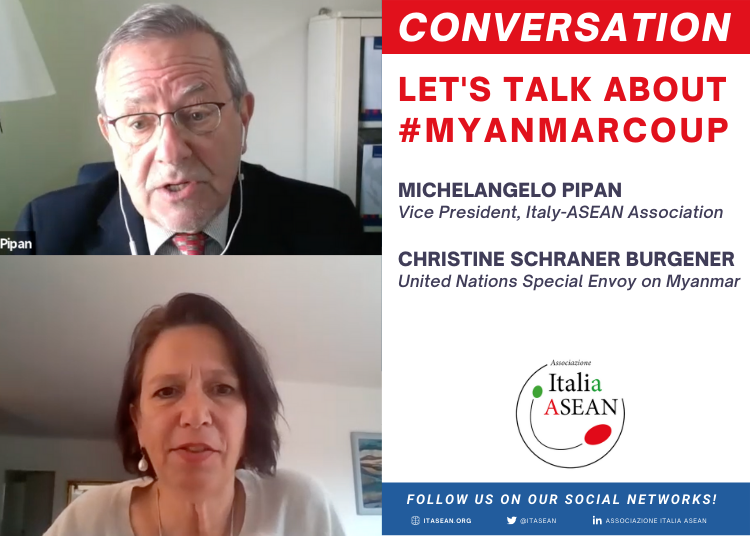
Il Vicepresidente Pipan conversa con l’Inviata Speciale ONU in Myanmar

In data 26 marzo 2021, il Vicepresidente esecutivo dell’Associazione Italia-ASEAN, Ambasciatore Michelangelo Pipan ha svolto una conversazione con l’Ambasciatrice Christine Schraner Burgener, Inviata speciale delle Nazioni Unite in Myanmar, sugli sviluppi del recente colpo di Stato birmano. Durante la discussione, sono stati toccati diversi temi quali l’impatto del golpe sulla società civile, la reazione della comunità internazionale, l’impatto sulla popolazione di eventuali sanzioni e il futuro degli investimenti esteri nel Paese.

VEDI SUBITO LA CONVERSAZIONE INTEGRALE


Richiamando gli spiacevoli accadimenti del 2018 con il genocidio dei Rohingya, il Vicepresidente Pipan ha posto l’accento su come il recente colpo di Stato rappresenti il culmine di una situazione di instabilità politica, notevolmente alimentata nel corso degli anni. I recenti sviluppi in Myanmar, infatti, riportano dati allarmanti ed è stato chiesto all’Ambasciatrice Schraner Burgener, Inviata speciale delle Nazioni Unite in Myanmar, un parere sull’impatto che l’attuale situazione politica avrà sulla popolazione. In tal senso, l’Ambasciatrice ha sottolineato come l’avvento al governo delle forze armate, i Tatmadaw, abbia rallentato drasticamente il processo di democratizzazione nel Paese e nonostante essi abbiano previsto la realizzazione di una roadmap istituzionale prima di svolgere nuove elezioni, il percorso non sarà affatto semplice. Le forze armate intendono, in primo luogo, procedere all’identificazione e all’arresto dei soggetti legati al governo democraticamente eletto lo scorso novembre e, in secondo luogo, dimostrarne l’illegittimità. In questo contesto, la popolazione è impossibilitata a lavorare e la chiusura delle banche ostacola i cittadini nel poter gestire i propri risparmi, incentivando spostamenti e migrazioni e mettendo a rischio la delicata situazione sanitaria nella regione.

In riferimento a quanto detto, il Vicepresidente Pipan ha rivolto una domanda sulla reazione da parte della comunità internazionale, interrogandosi, inoltre, sulla possibilità di un eventuale rallentamento delle proteste da parte della società civile, come nel caso della Thailandia, che ha assistito a diverse manifestazioni durante lo scorso anno, rallentate poi verso la fine del 2020. Per quanto concerne il primo quesito, l’Amb. Schraner Burgener ha analizzato la reazione delle grandi super potenze, Stati Uniti e Cina, che hanno condannato i recenti sviluppi, invitando tramite dichiarazioni ufficiali a un ritorno allo status quo. In relazione al secondo punto, l’Ambasciatrice ha espresso ottimismo e fiducia sul futuro delle relazioni tra la popolazione locale e le minoranze etniche. In seguito all’esperienza dei Rohingya, infatti, la popolazione birmana ha mostrato maggiore vicinanza e comprensione nei confronti del variegato tessuto etnico del Paese, creando relazioni più solide con altri gruppi armati etnici. Il contesto attuale ha, quindi, promosso un dialogo più aperto sull’adozione di una strategia comune.

Un ulteriore punto di discussione è stato fornito ponendo l’accento sul ruolo assunto dall’ASEAN durante l’attuale emergenza in Myanmar. In tal senso, l’Amb. Schraner Burgerner ha confermato come l’Association stia reagendo in modo inedito rispetto agli schemi del passato, maggiormente improntati invece sul principio di non-interferenza. È stato, infatti, menzionato l’appello fatto dal Presidente indonesiano Joko Widodo a svolgere un vertice dedicato alla risoluzione della crisi in Myanmar e parallelamente sono stati elogiati lo spirito d’iniziativa da parte dei Ministri degli Affari Esteri di alcuni Paesi Membri, quali Indonesia e Singapore. Nonostante, infatti, alcuni Paesi ASEAN siano ancora restii alla possibilità di interferire direttamente a livello istituzionale, come nel caso del Laos e della Thailandia, c’è un forte interesse a mantenere la stabilità socioeconomica, nonché politica, della regione e ad interessarsi direttamente alla grave fase storica vissuta dal Myanmar.

L’ultima domanda del Vicepresidente Pipan, infine, ha evidenziato il ruolo delle sanzioni nella risoluzione delle crisi internazionali e come queste possano impattare l’afflusso di investimenti esteri nel Paese. In tal senso, l’Amb. Schraner Burgener ha osservato che il tipo di sanzioni da applicare dovranno essere mirate e volte ad intaccare i mezzi di sostentamento delle forze armate. La stessa popolazione locale, stando alle parole dell’Inviata speciale, fa appello alla comunità internazionale, richiedendo che i Tatmadaw vengano isolati e privati dei mezzi finanziari dei conglomerati dell’industria mineraria e del settore alberghiero (Myanma Economic Holdings Limited e Myanmar Economic Corporation). L’Amb. Schraner Burgener ha evidenziato, infatti, la necessità di imporre sanzioni che non abbiano ricadute gravi sulla società e che possano promuovere il ritorno in carica del precedente governo di Aung San Suu Kyi. Per quanto concerne, infine, il futuro del commercio, l’Inviata Speciale delle Nazioni Unite auspica un aumento degli investimenti nel Paese, soprattutto per progetti rivolti al potenziamento delle infrastrutture, che si pongano come obiettivo primario il netto miglioramento delle condizioni sociali dei cittadini birmani.


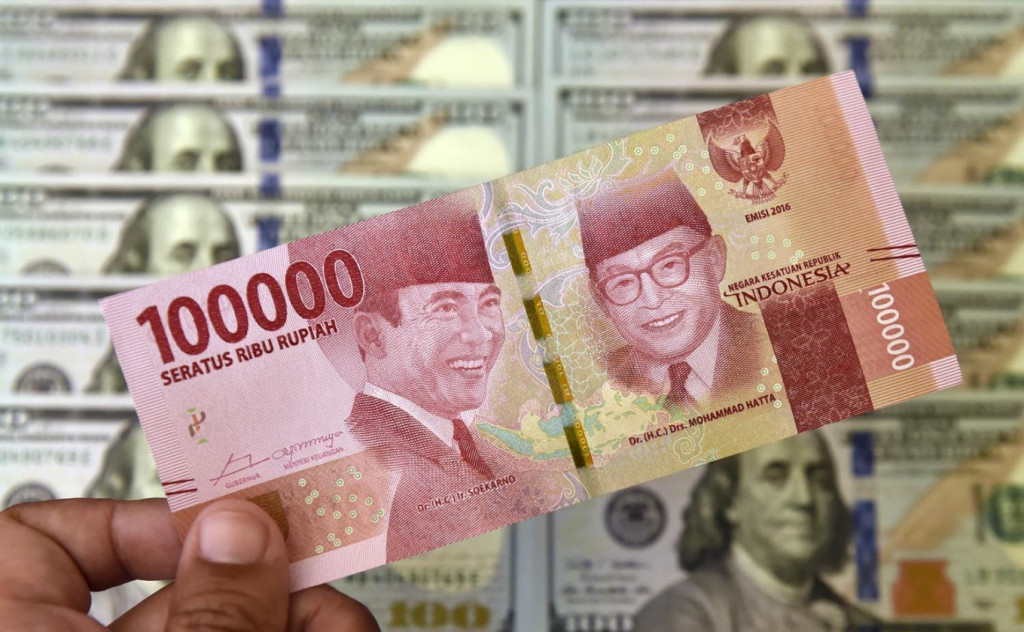
Indonesia opens up to foreign investment

Indonesia change tack and opens up to foreign investment, as part of the reforms planned by the implementation of the Omnibus Law

The Presidential Decree 10/2021, also dubbed as “Positive Investment List”, took effect on March 4, 2021, outlining the new list of business fields open to investment. This regulation is included in the implementation of the so-called “Omnibus Law”, the largest economic reform plan ever launched in Indonesia and replaces Presidential Decree no. 36/2010, which listed the sectors closed to investment and those open under specific conditions.

Approved on October 5, 2020, the controversial Omnibus Law (UU 11/2020 Cipta Kerja) mainly aims to create new jobs, encourage domestic and foreign investment, and stimulate the economy through the simplification of bureaucratic processes and the speeding up of political decisions. However, strong disapproval was expressed by trade unions and workers' rights associations, epitomized in massive protests throughout October to condemn the law for the damage caused to wages, job safety and to environmental protection, with further centralization of power in Jakarta.

The new investment list has significantly reduced the number of sectors that are completely closed to any form of investment (foreign or local) and those that are totally closed or partially open to foreign investment. This aligns with the government's efforts to counter the impact of the Covid-19 pandemic by encouraging the arrival of more FDI in Indonesia. The decree certainly represents one of the major liberalizations of foreign capital: before the introduction of the Omnibus Law, the country did not have a comprehensive system to promote investments.

Important sectors such as telecommunications, transportation, energy, distribution and construction services, which were severely restricted in previous years, have been opended up to foreign investment and stimulated with fiscal incentives, such as corporate income tax reductions. Additional benefits include the provision of support infrastructures to foreign companies, as well as energy and raw materials, together with simplified business licensing. In addition, foreign investments in technology start-up sectors in Special Economic Zones have been exempt from the minimum investment threshold of IDR 10 billion.

The business fields have been classified into 4 main categories, emphasizing the group of priority sectors. Within the latter category, 245 business areas now open to foreign investment have been outlined. Priority sectors also include some industries that are strategic for the country's economic development, such as the processing and refining of nickel, a key material in electric vehicle (EV) batteries. Indonesia is home to the world's biggest nickel reserve and plans to become EV battery production hub, developing a complete supply chain for nickel, from the extraction of raw materials to the manufacturing of the batteries themselves. Tesla has recently put forward its investment proposal to help Indonesia implement its ambitious plans in this direction.

Hence, Indonesia sends a strong message to the international economic community, putting on paper the list of new business opportunities. The openness to foreign investment enshrines a new and valuable approach for the future of the country.

Women and sustainability: a pivotal combination for development

Women and sustainability are interrelated factors: adopting a gender perspective towards Southeast Asian development might support post-pandemic economic recovery 

Gender equality and climate change are endemic problems in Southeast Asia, and Covid-19 made them even more urgent. Good news is that ASEAN is not alone: the 2030 UN Agenda for Sustainable Development confirms the international commitment on these issues and systematizes further challenges. However, highly context-specific features play a vectoral role in the region, since it is hardly affected by climate change, and it damages disadvantaged people such as indigents and women – that often coincide.

The ASEAN Gender Outlook acknowledges ASEAN’s efforts towards gender equality, but it emphasizes that economic consequences of the Covid-19 pandemic are deemed to compromise these results. Indeed, women and girls in Southeast Asia are regarded as being hardly affected by the economic crisis. Systemic discriminations that are inherent to cultural practices, further aggravated by other factors such as predatory economic imperatives, are very influential on women’s condition. Therefore, considering that inequality is a multi-layered issue, governments are required to adopt a comprehensive perspective that values this complexity.

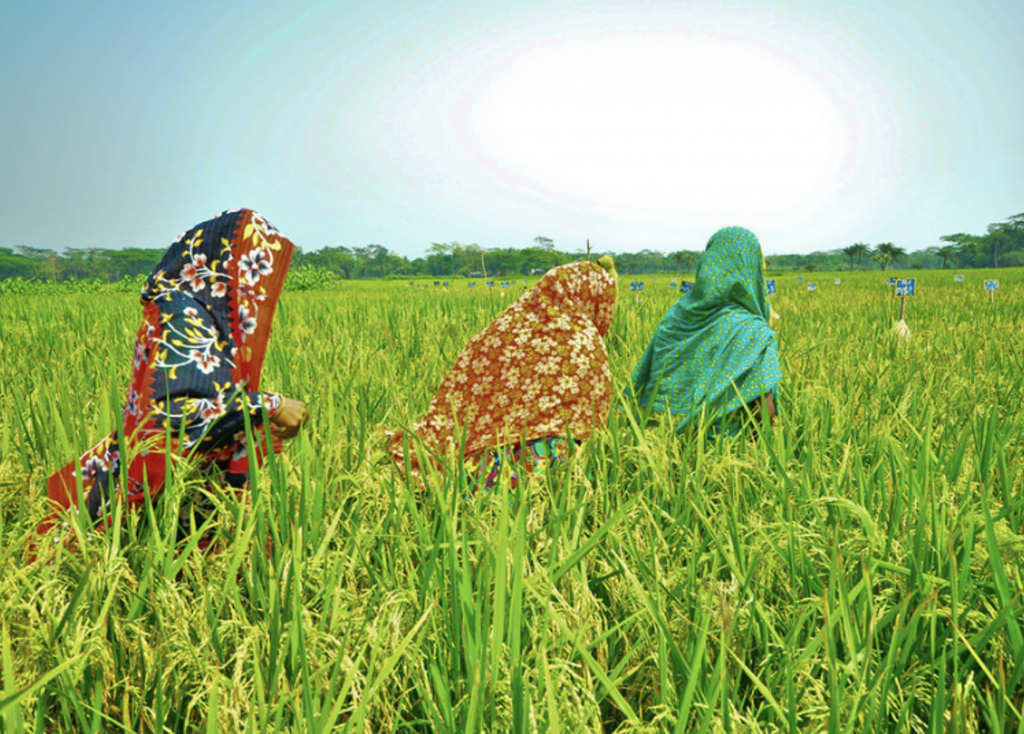
Given the aforementioned specificities of the region, women and sustainability are key concepts for development. According to a FAO report titled Rural women and girls 25 years after Beijing, 39% of women living in rural areas are employed in agricultural sectors. As we mentioned in a previous article, climate change is particularly inclement in Southeast Asia, affecting agriculture – leading sector of the regional economies. The overall picture is further worsened by industry-led urbanization that moved most of male labor force towards cities, leaving women in the countryside. This movement consequently produced a ‘feminization’ of agricultural work in the region.

This scenario clearly describes how women employed in agriculture are dangerously exposed to climate change effects. The situation is aggravated by the fact that feminization in agriculture did not mean a feminization of land’s right. Decision-making still relies on men. ASEAN Gender Outlook estimates that 24% of Southeast Asian lands are less fertile than in the past, and that women suffer from environmental degradation without agency to change situation: they cannot avoid the abuse of pesticides and the use of monocultures.

Adopting a gender perspective in Southeast Asia means including marginalized instances such as environmental degradation and agricultural development, economic growth and social justice. In conclusion, considering women and sustainability as interrelated factors might enhance post-pandemic recovery for ASEAN countries.

Myanmar: sanzioni UE per il colpo di Stato militare

COMUNICATO STAMPA DEL CONSIGLIO DELL’UNIONE EUROPEA

Oggi il Consiglio ha imposto misure restrittive nei confronti di undici persone responsabili del colpo di Stato militare perpetrato in Myanmar/Birmania il 1° febbraio 2021 e della successiva repressione militare e di polizia contro manifestanti pacifici.

Dieci delle undici persone interessate sono ufficiali del più alto rango delle forze armate del Myanmar/Birmania (Tatmadaw), tra cui il comandante in capo Min Aung Hlaing e il vicecomandante in capo Soe Win. L’undicesima è il nuovo presidente della commissione elettorale dell’Unione, in ragione del ruolo che ha svolto nell’annullamento dei risultati delle elezioni del 2020 in Myanmar/Birmania.

Multilateralism, digitalization, and sustainability

EU’s agenda for its new Trade Strategy

On February 18th, 2021 the European Commission released the guidelines for a new “Trade Strategy”. The document determines the Union’s approach in trade with third countries in the years to follow.

It seems clear that the keyword will be “open strategic autonomy”. Open autonomy in recovering economically from the COVID-19 pandemic, thanks to the green and digital revolutions. Open autonomy in renovating multilateralism. Above all, open autonomy in reforming substantially the World Trade Organization (WTO).

The transition to a more sustainable economy is probably the main challenge. The goals set by the European Green Deal, a set of policy initiatives by the European Commission to make Europe climate neutral by 2050, are ambitious, numerous, and urgent. For this reason, one of the first targets of the new Strategy is to strengthen the environment safeguard clauses already present in the Free Trade Agreements (FTAs) that the EU signs with third countries. The respect of these clauses will be monitored very closely. Simultaneously, the fight against illegal trade will become stricter, to ensure the rights of citizens, workers, and farmers.

The second challenge is the digital revolution. The EU aims to enact new guidelines for “digital commerce”, that is the buying and selling of goods and services using digital channels such as the Internet and mobile networks. According to the Commissiona, over 60% of global GDP was represented by e-commerce transactions in 2018. Numbers that have grown sharply during the COVID-19 pandemic. However, the Commission strongly advises against those countries that impose discriminatory measures to promote their own digital competition at the expense of others. In the new Strategy, the EU pushes to ensure more cross-border data flows, but in respect of the EU’s legal framework on personal data protection. One of the most ambitious objectives is to ban unjustified data localisation requirements by apps and websites when they are not strictly necessary.

The reform of the WTO is essential to reach these goals. The Commission’s Strategy highlights the need to reinforce environment safeguard clauses not only in its FTAs but also internationally, by applying them to all those countries that want to keep trading goods, property, or services worldwide.

The WTO, with the appointment of the new Director-General Ngozi Okonjo-Iweala last March 1st, already made it through a complex deadlock situation: the appointment of the institution's governing bodies, blocked by the Trump administration for more than three years. The Nigerian economist received approval by both the EU and the White House under the new Biden administration. She is both the first woman and first African representative to be elected Director-General. Many hope that she is “the right woman in the right place” to put an end to the trade rivalry and increasing protectionism between the Union and the US. And to solve the trade war between China and the US, since this latter posed tariffs “inconsistent” with trade rules on China goods in 2018. Supported by the new administration, the EU hopes to export to the WTO its model of a digital and green transition.

The target of posing its strategic autonomy at the core, towards a Union that alone can reach its goals and pursue its global agenda on multilateralism, digitalisation, and climate change, is admirable. It is impossible not to notice, however, the lack of a strategy to relaunch relations with the Indo-Pacific area. Particularly Tiger Economies have been shining for their successes in the digital development field for a long time. Moreover, they are part of that group of countries most interested in the fight against climate change, seen their geographical position particularly prone to environmental disasters. Europe is already putting more emphasis on the Indo-Pacific. Several FTAs with Japan, Vietnam, Singapore, ongoing negotiations with Australia, Indonesia, and Malesia, and the development by the Commission of an “Indo-Pacific Strategy” are all tangible examples. However, more focus on this area of the world from the trade point of view remains crucial to give a boost to the new Strategy and to strengthen the position of the EU in the global arena.   

Recently active members
Foto del profilo di Alessio
Foto del profilo di Monika
Foto del profilo di Gabriel
Foto del profilo di Elena
Foto del profilo di Lorenzo
Foto del profilo di Alessandro
Foto del profilo di Cristina
Foto del profilo di Rocco
Foto del profilo di Clara Lomonaco
Foto del profilo di Redazione
Foto del profilo di Davide Gugliuzza
Foto del profilo di Anna Affranio
Foto del profilo di Ilaria Canali
Foto del profilo di Nicolò
Foto del profilo di Angelo Cangero
Who is online
There are no users currently online
Members
  • Foto del profilo di Alessio
    Active 5 ore, 1 minute fa
  • Foto del profilo di Monika
    Active 3 giorni, 12 ore fa
  • Foto del profilo di Gabriel
    Active 3 settimane, 4 giorni fa
  • Foto del profilo di Elena
    Active 1 anno, 4 mesi fa
  • Foto del profilo di Lorenzo
    Active 2 years, 6 mesi fa